

Introduction
Cloudflare stock (NYSE: NET) represents an investment in a technology company that provides internet infrastructure, cybersecurity, website performance and developer services. Its products help businesses protect applications, manage internet traffic and build software on a global network.
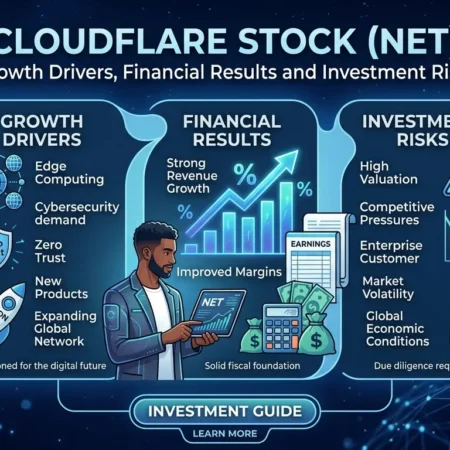
The company has attracted investor attention because of its expanding security platform, developer tools and opportunities related to artificial intelligence (AI). In its second quarter of 2026, Cloudflare reported revenue of $696.1 million, up 36% year over year. However, the same results showed a substantial GAAP operating loss, demonstrating why revenue growth alone does not determine whether a stock is attractively priced. Source: Cloudflare’s Q2 2026 results.
For investors researching NET stock, the main questions are whether Cloudflare can sustain its growth, improve profitability, compete effectively and justify its market valuation. A strong business can still be an expensive investment if its share price already reflects high expectations.
This article is for educational purposes only and does not constitute financial advice or a recommendation to buy or sell any security.
1. What Is Cloudflare?
Cloudflare, Inc. is a technology company that provides services designed to make websites, applications and internet-connected systems faster, more secure and more reliable.
Its global network sits between users and the online services they access. Depending on the product, Cloudflare can help filter malicious traffic, accelerate content delivery, protect applications and provide infrastructure for developers.
Businesses ranging from smaller website operators to large enterprises use these types of services to manage their online operations.
What services does Cloudflare provide?
Cloudflare’s products cover several related areas:
- Content delivery and performance: Helps websites deliver content efficiently to visitors.
- Cybersecurity: Offers protection against distributed denial-of-service (DDoS) attacks, malicious bots and other online threats.
- Application security: Provides tools such as web application firewall capabilities to help protect websites and applications.
- Zero Trust and network security: Helps organisations manage access to internal applications and secure connections.
- Developer services: Offers platforms and tools for running code and building applications on its network.
- AI-related infrastructure: Develops services intended to support applications, automated agents and changing patterns of internet traffic.
The combination matters because customers may be able to use several products from one provider instead of managing a collection of disconnected services.
For investors, the important question is whether this broad offering helps Cloudflare win more customers, increase spending from existing accounts and generate sustainable profits.
2. What Is Cloudflare Stock (NET)?
Cloudflare trades on the New York Stock Exchange under the ticker symbol NET. Investors searching for Cloudflare stock , NET stock price or Cloudflare share price are generally researching the publicly traded shares of Cloudflare, Inc.
The stock’s value reflects market expectations about the company’s future revenue, profitability, competitive position and cash generation. It can also respond to interest rates, technology-sector sentiment, earnings announcements and changes in investors’ willingness to pay for growth.
Why do investors follow NET stock?
Cloudflare operates in several technology markets that investors closely monitor, including cybersecurity, cloud infrastructure, application development and AI-related services.
That gives the company multiple potential sources of growth. Nevertheless, it also means investors must evaluate a complicated business rather than rely on a single product or market trend.
A share price increase does not automatically mean the business has become proportionately more valuable. Likewise, a price decline does not necessarily make the shares cheap. Understanding the relationship between business performance and valuation is essential.
3. How Does Cloudflare Make Money?
Cloudflare generates revenue by selling access to its internet infrastructure, security products, performance tools and developer platform.
Its commercial opportunity depends partly on customers’ need for reliable digital services. As organisations expand online operations, protect sensitive applications and adopt more sophisticated software, they may need additional security, networking and computing capabilities.
Subscription and usage-based services
Cloudflare offers products through different commercial arrangements. Customers may pay recurring fees for plans and services, while some developer and infrastructure products can involve usage-related charges.
Recurring revenue can make future business performance more predictable, although customer retention, contract expansion and product usage still influence results.
Enterprise customer expansion
Large organisations often have complex security and networking requirements. Winning an enterprise customer may create opportunities to sell additional products over time.
For example, a business that initially uses Cloudflare for application security may later evaluate its network security or developer products. This potential expansion can increase revenue without requiring the company to acquire an entirely new customer for every service.
However, cross-selling is not guaranteed. Customers may prefer competing products, negotiate lower prices or limit their spending.
Developer platform adoption
Cloudflare’s developer tools give it an opportunity to serve businesses building and running software. Greater adoption could help broaden its customer base beyond traditional website performance and security services.
The financial benefit depends on whether developers turn into paying customers and whether product usage generates revenue at attractive margins.
4. Cloudflare’s Latest Financial Results
Investors should begin with the company’s published financial statements rather than relying only on social media commentary or short-term stock movements.
Cloudflare’s second-quarter 2026 results, announced on 6 August 2026, provide a useful example of how to evaluate growth alongside profitability.
Key financial figures
| Metric | Q2 2026 result |
|---|---|
| Revenue | $696.1 million |
| Year-over-year revenue growth | 36% |
| GAAP gross margin | 71.8% |
| Non-GAAP gross margin | 73.1% |
| GAAP operating loss | $205.7 million |
| Non-GAAP operating income | $96.1 million |
| GAAP net loss | $170.0 million |
Source: Cloudflare’s Q2 2026 financial results. Figures are in US dollars. GAAP and non-GAAP figures use different accounting treatments and should not be compared as though they were identical measures.
Revenue growth remains an important indicator
Revenue increased by 36% compared with the same quarter a year earlier. This indicates that Cloudflare continued to expand its business during the reported period.
Investors should also examine the sources of that growth. New customer acquisitions, larger enterprise contracts, increased spending by existing customers and stronger demand for newer products can have different implications for future performance.
A high growth rate is encouraging, but its sustainability matters more than a single quarter’s result.
Profitability requires closer examination
Cloudflare reported a GAAP operating loss of $205.7 million in Q2 2026, while its non-GAAP operating result was positive.
This difference is important. Non-GAAP measures exclude certain expenses under the company’s chosen reporting methodology, so investors should review the reconciliation between adjusted and GAAP results.
Stock-based compensation, research and development costs, sales spending and infrastructure investment can all influence profitability and shareholder returns. An investor should not assume that adjusted operating income means the business is already consistently profitable under standard accounting rules.
Cash flow provides another perspective
Operating cash flow and free cash flow help show how effectively a company converts its business activity into cash.
Investors should review these measures over multiple quarters, paying attention to working-capital changes, capital expenditure and the effect of stock-based compensation. A single quarter may not represent the company’s normal cash-generation capacity.
For the complete picture, consult Cloudflare’s quarterly filing with the SEC.
5. Key Growth Drivers for Cloudflare Stock
Several developments could influence Cloudflare’s future performance. Each represents a potential opportunity rather than a guaranteed outcome.
5.1 Rising demand for cybersecurity
Cyberattacks, automated abuse and increasingly complex digital systems create ongoing demand for security services.
Businesses need ways to protect websites, applications, APIs and networks without creating unnecessary friction for legitimate users. Cloudflare’s combination of performance and security products may appeal to organisations looking to consolidate their technology providers.
The investment question is whether this demand translates into durable customer growth, stronger retention and higher revenue per customer.
5.2 Artificial intelligence and AI infrastructure
AI is changing how software is developed and how users discover and access online information. AI applications and automated agents may require additional computing infrastructure, security controls and tools for managing traffic.
Cloudflare could benefit if its developer platform and network become more important to these applications. The company has also been developing products and partnerships connected with AI-related workflows.
However, investors should distinguish between an emerging market opportunity and revenue that has already been demonstrated in financial results. AI-related announcements do not automatically establish the size, profitability or timing of future commercial benefits.
5.3 Growth in enterprise accounts
Large customers can represent meaningful opportunities because their requirements often extend across multiple products and locations.
If Cloudflare expands its relationships with enterprise customers, it may be able to increase recurring revenue and deepen customer dependence on its platform.
Investors should monitor large-customer growth, customer concentration, remaining performance obligations and the company’s commentary about contract expansion.
5.4 Demand for developer tools
Software teams increasingly look for ways to build, deploy and operate applications efficiently. Cloudflare’s developer products may help the company reach customers who are creating new applications or modernising existing systems.
The challenge is converting adoption into revenue while competing with established cloud platforms and specialised development services.
5.5 Platform consolidation
Some organisations prefer to reduce the number of separate vendors they manage. A provider offering networking, security, performance and development tools may benefit from this preference.
Cloudflare’s opportunity depends on demonstrating that a broader platform provides measurable value, acceptable reliability and competitive pricing. Customers can still choose best-of-breed products from multiple suppliers if those solutions better meet their needs.
6. Potential Benefits of Investing in NET
Investors evaluating Cloudflare stock may identify several potential advantages.
Exposure to multiple growing markets: Cloudflare participates in internet infrastructure, cybersecurity, software development and AI-related services rather than relying on one narrow product category.
Potential for recurring revenue: Subscription-based products can support revenue visibility when customers renew and expand their contracts.
Cross-selling opportunities: An established customer relationship may provide opportunities to introduce additional products, potentially increasing customer value over time.
Technology platform potential: If Cloudflare becomes more deeply embedded in customers’ operations, switching providers may become more complicated. Strong retention can support long-term revenue, although it should be verified through reported customer metrics.
Operating leverage potential: If revenue grows faster than operating expenses over time, profitability could improve. This outcome depends on spending discipline and the economics of delivering services at scale.
These are possible business strengths, not proof that NET is undervalued. A high-quality company can still deliver disappointing investment returns when investors pay too much for its expected growth.
7. Risks Investors Should Understand
A balanced assessment of Cloudflare stock needs to consider what could go wrong as well as what could go right.
7.1 Valuation risk
Growth-oriented technology stocks can trade at elevated multiples of revenue or earnings. When expectations are high, even solid financial results may disappoint investors if they fall short of forecasts.
A lower share price does not automatically mean a bargain. Investors should compare the company’s valuation with its expected growth, cash generation, margins and relevant competitors.
7.2 Continuing GAAP losses
Cloudflare’s Q2 2026 GAAP operating and net losses show why profitability remains an important area to monitor.
Investors should look for evidence that revenue growth can translate into improving operating margins and sustainable cash flow. If expenses continue rising rapidly, the business may struggle to convert growth into attractive shareholder returns.
7.3 Competition
Cloudflare competes across markets with different types of providers, including major cloud platforms, cybersecurity specialists, networking companies and application-delivery vendors.
Competitors may have broader product portfolios, established enterprise relationships or greater financial resources. Pricing pressure and rapid technological changes could also affect Cloudflare’s ability to maintain its position.
7.4 Service disruptions and cybersecurity incidents
Cloudflare’s services support important online operations. A major outage, security incident or reliability problem could disrupt customers, damage trust and create financial or reputational consequences.
Even a company with strong technical capabilities cannot eliminate all operational risk. Investors should consider reliability, incident response and the potential consequences of service interruptions.
7.5 AI expectations may not translate into profits
AI could create new demand for Cloudflare’s products, but market enthusiasm can move faster than actual commercial results.
Some new services may attract users without producing substantial revenue. Others may require investment in infrastructure, research or sales before becoming profitable. Investors should assess measurable adoption and financial contribution rather than treating every AI announcement as a confirmed growth driver.
7.6 Share-based compensation and dilution
Technology companies sometimes use equity awards to recruit and retain employees. Stock-based compensation is a real expense for shareholders to consider, even when it is excluded from adjusted earnings measures.
Investors should review stock-based compensation, diluted share counts and the company’s approach to managing dilution over time.
7.7 Broader market conditions
Interest rates, investor sentiment and economic conditions can affect the valuation of growth stocks. When investors become less willing to pay for future earnings, a company may experience a sharp share-price decline even if its underlying business continues to expand.
These factors can make NET stock volatile and complicate short-term price predictions.
8. How to Evaluate Cloudflare Stock
Rather than making a decision based on a headline or price target, investors can use a consistent framework.
Review the following metrics
| Metric | What to investigate |
|---|---|
| Revenue growth | Is growth consistent, accelerating or slowing? |
| Gross margin | Can Cloudflare maintain attractive service economics? |
| GAAP operating margin | Are operating losses narrowing or turning into profits? |
| Free cash flow | Is the company generating cash consistently? |
| Stock-based compensation | How much does equity compensation affect shareholder economics? |
| Customer metrics | Are large customers and existing-account spending expanding? |
| Valuation | Does the current price reasonably reflect expected future performance? |
| Competitive position | Can Cloudflare differentiate its products and retain customers? |
Compare valuation with growth
Price-to-sales (P/S) is one metric investors may use when assessing a fast-growing company that is not consistently profitable under GAAP.
The calculation is:
Price-to-sales ratio = Market capitalisation ÷ Annual revenue
A higher multiple means investors are paying more for each dollar of current revenue. That premium may be justified if growth and future profitability are strong, but it can create downside risk if expectations are not met.
The P/S ratio should not be used in isolation. Compare it with similar companies, expected growth rates, margins, cash flow and the company’s historical valuation range. Business models differ, so simple comparisons can be misleading.
Read company filings and earnings announcements
Official earnings releases and SEC filings provide information about financial performance, risks, management commentary and accounting adjustments.
Investors should prioritise primary sources over promotional articles, anonymous predictions and social media claims. Analyst estimates can provide context, but they remain forecasts rather than guaranteed outcomes.
9. Cloudflare Stock Outlook: What Could Happen Next?
Cloudflare’s future share-price performance will depend on the interaction between business results and the valuation investors assign to those results.
Three broad scenarios can help frame the possibilities without pretending to predict an exact price.
Bullish scenario
Cloudflare sustains strong revenue growth, expands enterprise relationships, converts AI and developer adoption into meaningful sales, and improves profitability. If these results exceed market expectations, the stock could benefit.
Even in this scenario, returns depend on the price investors pay and whether the valuation remains reasonable.
Base scenario
Revenue continues to grow, but profitability improves gradually and the business faces normal competitive pressures. The share price could fluctuate as investors reassess the balance between growth, margins and valuation.
In this case, operational progress may not always lead to immediate share-price gains.
Bearish scenario
Growth slows, expenses remain elevated, competition intensifies or AI-related opportunities produce less revenue than expected. If the market also reduces the valuation multiple assigned to the business, the share price could fall substantially.
These scenarios are illustrative frameworks, not price forecasts or probabilities.
What should investors watch in late 2026?
As of 19 October 2026, Cloudflare’s latest published quarterly results are for Q2 2026. The company announced that it plans to report its third-quarter 2026 financial results on 5 November 2026. Investors should verify the date and review the release when it becomes available.
Useful areas to monitor include:
- Quarterly revenue growth and management’s forward guidance.
- GAAP and adjusted operating margins.
- Free cash flow and stock-based compensation.
- Enterprise customer growth and contract commitments.
- Evidence of commercial demand for AI and developer products.
- Changes in competitive conditions and valuation.
The next earnings release may update the investment case, but a single report should be evaluated alongside longer-term trends.
10. How to Research NET Stock Before Investing
A practical research process can help investors avoid decisions driven solely by market excitement.
- Confirm the latest share price. Check a reliable financial platform for current pricing, trading volume and recent performance. Market prices change continuously during trading.
- Read the latest earnings release. Start with the company’s revenue, margins, losses, cash flow and forward guidance.
- Review the SEC filing. Look for risk factors, stock-based compensation, financial details and disclosures that may not be prominent in a headline.
- Calculate valuation metrics. Compare market capitalisation and revenue, and consider earnings and cash-flow measures where appropriate.
- Compare competitors. Examine their growth, profitability, product offerings and valuation using consistent periods and accounting measures.
- Consider your time horizon and risk tolerance. A volatile growth stock may not suit every investment strategy.
- Revisit the thesis after results. Decide which financial or operational developments would strengthen or weaken your original assessment.
Useful starting points include Cloudflare Investor Relations and the SEC’s Cloudflare filings.
Final Thoughts
Cloudflare stock offers exposure to a company operating across internet infrastructure, cybersecurity, developer services and emerging AI-related markets. Its 36% year-over-year revenue growth in Q2 2026 highlights the business’s momentum, but its GAAP operating loss also demonstrates why growth needs to be assessed alongside profitability and cash generation.
For investors, the central task is to determine whether Cloudflare can sustain demand, improve its financial performance and deliver results that justify its market valuation. Reviewing official filings, comparing competitors and examining risks can provide a more useful foundation than relying on short-term price movements or optimistic predictions.
What is Cloudflare stock?
Cloudflare stock is the publicly traded equity of Cloudflare, Inc., listed on the New York Stock Exchange under the ticker NET. The company provides internet infrastructure, cybersecurity, performance and developer services.
Is Cloudflare stock a good investment?
Whether NET is a suitable investment depends on its current valuation, growth prospects, profitability, competitive position and an investor’s risk tolerance. Strong revenue growth alone is not enough to establish that a stock is attractively priced.
What does Cloudflare do to generate revenue?
Cloudflare sells access to services related to website performance, application security, networking, Zero Trust security and developer infrastructure. Revenue comes from customer purchases and contracts across these product areas.
Is Cloudflare profitable?
Cloudflare reported a GAAP operating loss of $205.7 million and a GAAP net loss of $170.0 million for Q2 2026, while reporting positive non-GAAP operating income. Investors should distinguish adjusted results from GAAP profitability and review subsequent filings for updates.
Does Cloudflare benefit from artificial intelligence?
Cloudflare may benefit from AI-related demand for infrastructure, security and developer services. The extent of the benefit depends on customer adoption, monetisation, competition and the cost of delivering these services. AI potential should not be confused with guaranteed future revenue.





No Comment! Be the first one.