

Introduction
Finding funding is one of the most important decisions a growing business can make. The right capital can support hiring, product development, marketing, expansion, technology investments, or additional working capital. The wrong financing structure, however, can create repayment pressure, unnecessary dilution, or long-term financial constraints.
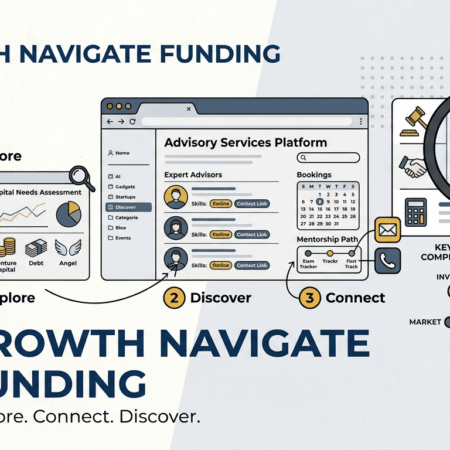
The phrase Growth Navigate Funding can be confusing because it is used in more than one way online. In general business discussions, it can describe the process of matching funding with a company’s growth stage, objectives, cash requirements, and risk profile. At the same time, Growth Navigate Funding is also the name used by a commercial startup fundraising advisory service that markets services such as fundraising strategy, pitch-deck development, investor introductions, financial modeling, and due-diligence preparation.
That distinction matters when researching the term.
A funding strategy is not the same thing as a financial product. An advisory company is not necessarily the lender or investor providing the capital. Understanding those differences can help founders evaluate funding opportunities more carefully.
This guide explains what Growth Navigate Funding means, how the advisory service presents its offerings, the funding options businesses may consider, its published pricing, potential benefits and limitations, important verification steps, and questions to ask before entering an engagement.
Quick Answer
Growth Navigate Funding can refer to a structured approach to securing capital for business growth or to the Growth Navigate Funding advisory brand.
The advisory company’s website says it works with startups from pre-seed through Series C and provides fundraising strategy, pitch decks, investor relations, financial modeling, growth strategy, due-diligence preparation, cap-table support, and market-expansion advisory.
Its website also advertises packages beginning at $4,500 per month, with a Navigator package listed at $9,500 per month and an Ascent package offered at custom pricing. These are advisory-service prices published by the company, not the cost of the underlying capital.
The company also publishes claims about capital raised, startups supported, investor relationships, and funding success rates. Those figures are company-reported claims and should not automatically be treated as independently audited performance statistics.
Growth Navigate Funding at a Glance
| Question | Answer |
|---|---|
| What is Growth Navigate Funding? | A term used for funding strategy and also the name of a startup fundraising advisory service |
| Main audience | Startups and growing businesses |
| Funding stages advertised | Pre-seed through Series C+ |
| Main services | Fundraising strategy, pitch decks, investor access, financial modeling and due diligence |
| Published starting package | $4,500/month |
| Navigator package | $9,500/month |
| Higher-level package | Ascent, custom pricing |
| Does advisory support guarantee funding? | No funding outcome should be assumed from advisory support alone |
| Is Growth Navigate necessarily the capital provider? | Its public materials primarily describe advisory and fundraising support |
| Should businesses verify the final funding source? | Yes |
| Are published performance statistics independently verified here? | No |
What Is Growth Navigate Funding?
The phrase growth navigate funding can be understood as a strategy for connecting capital decisions with business growth.
Instead of asking only, “How much money can we raise?”, a business should consider several questions:
- Why is the capital needed?
- What milestone will it fund?
- How much runway is required?
- Which funding structure fits the business?
- How much ownership can the founders reasonably dilute?
- Can the company support debt repayments?
- What happens if growth takes longer than expected?
This broader interpretation makes funding part of business planning rather than an isolated transaction.
There is also a specific commercial service using the Growth Navigate Funding name. Its public website describes a startup-focused advisory model that includes fundraising preparation, investor targeting, financial modeling, and post-funding growth support.
Because these meanings overlap in search results, anyone researching the phrase should first determine whether they are looking for general funding guidance or the specific advisory company.
What Does Growth Navigate Funding Advisory Offer?
According to its current service pages, Growth Navigate Funding promotes a range of services intended to support startups throughout the fundraising process.
The main services include:
1. Fundraising Strategy
The company says it develops funding roadmaps based on startup stage, sector, investor landscape, funding goals, and expected milestones.
Its published service description includes valuation benchmarking, investor targeting, investment-thesis development, competitive positioning, and fundraising timeline planning.
2. Pitch Deck Development
A pitch deck is often the first detailed presentation an investor sees from a startup.
Growth Navigate Funding says it develops investor-facing decks covering areas such as:
- Market opportunity
- Competitive landscape
- Team
- Traction
- Financial information
- Use of funds
- Business narrative
The company advertises a full 12–15-slide deck structure as part of this service.
3. Investor Relations and Network Access
Investor access is another major part of the service offering.
The company states that it maintains a network of more than 1,000 active investor relationships and provides targeted investor lists and warm introductions.
A useful distinction should be made here: an introduction is not the same as investment approval.
Investors still conduct their own evaluation, and the final decision remains with the investor or investment firm.
4. Financial Modeling
Financial models help investors understand how a company expects revenue, expenses, cash flow, and other financial variables to develop.
Growth Navigate Funding says its financial modeling service includes:
- Three-statement models
- Unit economics
- Cohort analysis
- Revenue forecasting
- Scenario analysis
- Sensitivity analysis
- Cap-table modeling
These services can be particularly relevant when a company is preparing for investor due diligence.
5. Due-Diligence Preparation
Investors can request extensive documentation before completing a transaction.
The company says it helps organize virtual data rooms, prepare financial and legal documents, stress-test assumptions, and prepare founders for investor questions.
6. Growth Strategy Advisory
Funding does not automatically create growth.
Once capital is raised, businesses still need to decide how that money will be deployed. Growth Navigate Funding says its post-funding advisory work can include go-to-market planning, revenue optimization, customer acquisition strategy, OKRs, follow-on funding preparation, and exit planning.
Who Is Growth Navigate Funding Designed For?
The company’s public materials indicate that its advisory services are aimed primarily at startups seeking capital from pre-seed through Series C and beyond.
That means the service may be relevant to several types of founders.
Pre-Seed Startups
At the pre-seed stage, the company may still be validating its product, market, business model, or customer demand.
The funding story therefore needs to explain why the opportunity exists and what the capital will accomplish.
Seed-Stage Companies
Seed-stage businesses typically need stronger evidence that the product and market can support growth.
Investors may examine traction, customer acquisition, unit economics, retention, market size, and the experience of the founding team.
Series A and Growth-Stage Businesses
Later-stage companies usually face greater expectations around predictable metrics, financial performance, market opportunity, organizational structure, and scalability.
At this point, financial modeling and due-diligence preparation can become particularly important.
How Does the Funding Process Work?
A structured fundraising process generally involves several stages.
Step 1: Define the Funding Requirement
Start with the business need rather than the amount an investor might be willing to provide.
For example, a company might need funding to:
- Hire engineers
- Launch a product
- Enter a new market
- Increase inventory
- Expand sales
- Extend runway
- Build infrastructure
A specific purpose creates a stronger basis for determining the required amount.
Step 2: Assess Funding Readiness
Before approaching investors or lenders, review:
- Revenue
- Cash flow
- Expenses
- Customer growth
- Retention
- Existing debt
- Ownership structure
- Intellectual property
- Legal documents
- Financial projections
Weak documentation can slow down fundraising even when the underlying business has potential.
Step 3: Select the Funding Type
The business then needs to determine whether equity, debt, grants, revenue-based financing, or another structure makes sense.
Different capital types create different obligations.
Step 4: Prepare Investor Materials
This stage can involve:
- Pitch deck
- Executive summary
- Financial model
- Cap table
- Data room
- Market research
- Customer information
- Use-of-funds plan
Growth Navigate Funding specifically markets pitch-deck development, financial modeling, investor targeting, and due-diligence preparation.
Step 5: Identify Potential Investors
Not every investor is suitable for every company.
A technology startup may target technology-focused venture funds. A climate startup may search for investors with climate or sustainability mandates.
Investor selection should consider:
- Sector
- Stage
- Geography
- Typical check size
- Portfolio
- Investment thesis
- Follow-on strategy
Step 6: Conduct Outreach
The next stage involves contacting potential investors, arranging meetings, presenting the company, and responding to questions.
Warm introductions can help establish contact, but they do not guarantee investment.
Step 7: Due Diligence
Investors may examine the company’s financials, contracts, intellectual property, customer relationships, ownership records, legal matters, and projections.
Accurate documentation becomes particularly important at this stage.
Step 8: Negotiate the Deal
A successful fundraising process may result in a term sheet or another formal financing proposal.
Founders should examine:
- Valuation
- Ownership dilution
- Investor rights
- Board rights
- Liquidation preferences
- Voting rights
- Protective provisions
- Option-pool changes
- Conversion terms
Legal counsel should review important transaction documents before signing.
What Funding Options Can Businesses Consider?
Growth funding is not limited to venture capital.
Equity Funding
Equity financing involves exchanging an ownership interest for capital.
The main advantage is that there is generally no scheduled loan repayment. The trade-off is dilution and potentially additional investor rights.
Business Loans
Debt financing allows a company to borrow money and repay it under agreed terms.
The company keeps its ownership, but repayment obligations create cash-flow pressure.
Angel Investment
Angel investors can provide capital during earlier stages.
Some also contribute industry experience, contacts, hiring support, or strategic guidance.
Venture Capital
Venture capital is generally intended for companies with significant growth potential.
VC financing can provide substantial capital, but it typically involves ownership dilution and investor involvement.
Grants
Grants can provide non-dilutive funding when a business qualifies for a specific program.
Eligibility varies considerably by government agency, industry, geography, and program objectives.
Revenue-Based Financing
This structure links repayment to business revenue rather than using a traditional fixed repayment schedule.
It can be useful in certain situations, but the total cost and repayment mechanics need careful review.
Growth Navigate Funding Pricing
One of the most important questions for anyone researching the service is cost.
Growth Navigate Funding’s current services page publicly lists three advisory packages.
Launchpad — $4,500 per month
The listed features include:
- Two-hour fundraising strategy session
- Pitch-deck review
- Investor targeting list with 50 contacts
- Financial model health check
- Monthly advisory call
- Email and Slack support
Navigator — $9,500 per month
The listed package includes:
- Full pitch-deck development
- Three-statement financial model
- Investor list with 200 targeted contacts
- Ten warm investor introductions per month
- Weekly advisory calls
- Data-room setup
- Cap-table review
Ascent — Custom Pricing
The highest-level package is listed with custom pricing.
Its published features include:
- Full-service fundraising retainer
- Dedicated senior advisor
- Investor introductions
- Due-diligence management
- Term-sheet negotiation support
- Post-close growth advisory
- Priority support
These figures are advisory fees, not interest rates or financing costs. They also do not represent the amount of capital a startup will receive.
Pricing should always be confirmed directly before entering an engagement because service packages can change.
What Does Growth Navigate Funding Claim About Its Results?
The company’s website publishes several performance figures.
Its About page currently states that the company was founded in 2013 and says it has worked with more than 300 startups, with more than $450 million in growth capital collectively secured. It also advertises a 92% funding success rate.
The website separately reports more than 1,000 investor relationships and an average 13-week time to close.
These numbers should be treated as claims published by the company, not as independently verified statistics in this article.
That distinction is important when evaluating any financial advisory provider.
If performance figures matter to your decision, ask for clarification about:
- How success is defined
- The period covered
- Number of clients included
- Whether unsuccessful engagements are included
- Whether the numbers have been independently audited
- Whether results vary by funding stage
A headline success rate can mean different things depending on its methodology.
Is Growth Navigate Funding Legitimate?
A website’s existence and professional presentation do not, by themselves, establish whether a financial service is appropriate for a particular business.
The better approach is transaction-level due diligence.
Before paying for advisory services or sharing sensitive business information, verify:
Legal Identity
Confirm the legal entity responsible for the engagement.
Contract
Request a written agreement describing the services, fees, duration, cancellation terms, and responsibilities of both parties.
Funding Source
Ask who actually provides the capital.
An advisory company may introduce a business to investors or lenders without being the party supplying the money.
Fees
Confirm whether the advisory fee is:
- Monthly
- Fixed
- Performance-based
- Success-based
- A combination
Data Handling
Financial statements, tax records, bank information, ownership documents, and customer information can be sensitive.
Understand who receives these documents and how they are used.
Funding Outcome
Do not assume that purchasing an advisory package guarantees a successful fundraising round.
Investor and lender decisions remain dependent on the company’s circumstances and the capital provider’s criteria.
Important Red Flags When Evaluating Funding Services
These checks apply to Growth Navigate Funding and to financial advisory providers generally.
Guaranteed Funding
Be cautious about any provider that promises guaranteed investment or loan approval before the actual capital provider conducts its evaluation.
Pressure to Pay Immediately
A legitimate business decision should allow enough time to review the agreement and understand the fees.
Unclear Capital Provider
You should know whether the money will come from a bank, private lender, angel investor, venture fund, or another source.
Vague Services
“Funding assistance” is not enough.
A contract should specify what the provider will actually do.
Unclear Refund Terms
Read cancellation and refund provisions before making a payment.
Excessive Data Requests
Provide sensitive financial information only after understanding why it is required and who will receive it.
Benefits of Using a Funding Advisory Service
A funding adviser can potentially reduce some of the administrative and strategic burden associated with fundraising.
Better Preparation
Financial models and pitch materials can be structured before investor conversations begin.
Investor Targeting
A targeted list can be more useful than sending the same pitch to hundreds of unrelated investors.
Fundraising Structure
Professional guidance can help founders think through funding stage, amount, timing, and investor fit.
Due-Diligence Preparation
Organizing documents early can reduce delays when investors begin detailed reviews.
Strategic Support
Some advisory services continue beyond the fundraising transaction and help companies plan how to deploy capital.
These benefits depend on the quality of the actual engagement and the suitability of the adviser for the company.
Limitations to Consider
Funding advisory services are not a substitute for strong business fundamentals.
A consultant cannot manufacture genuine product-market fit, sustainable revenue, or investor demand.
Costs can also become significant. At the published Launchpad price of $4,500 per month, even a three-month engagement would represent $13,500 in advisory fees before considering any other fundraising expenses.
Founders should therefore compare the advisory cost with the expected value of the service.
Another consideration is that investor introductions do not guarantee investment. The investor ultimately decides whether the opportunity fits its strategy.
Legal and financial advice may also require separate professionals. Founders should not assume that a fundraising consultant replaces an attorney, accountant, tax adviser, or regulated financial professional.
How to Decide Whether Funding Is Needed
Before looking for funding, calculate the company’s actual capital requirement.
A useful framework is:
Required Capital = Planned Expenses + Working Capital Requirement + Contingency − Available Cash
The number should then be connected to specific milestones.
For example:
| Funding Use | Example Milestone |
|---|---|
| Hiring | Build product team |
| Marketing | Reach defined customer-acquisition target |
| Product development | Launch new feature |
| Inventory | Support projected demand |
| Expansion | Enter a new geographic market |
| Infrastructure | Increase operational capacity |
The objective is to connect money with measurable outcomes.
Debt vs Equity: What Should Businesses Examine?
Neither debt nor equity is automatically suitable for every business.
| Factor | Debt | Equity |
|---|---|---|
| Ownership dilution | Usually no | Yes |
| Repayment | Required | Usually no scheduled repayment |
| Cash-flow pressure | Higher | Lower from repayment perspective |
| Investor involvement | Usually limited | Can be significant |
| Personal guarantees | Possible | Usually not structured as a loan guarantee |
| Best fit | Predictable cash flow | High-growth businesses seeking risk capital |
The right structure depends on the company’s financial position, growth expectations, risk tolerance, and objectives.
Practical Checklist Before Signing a Funding Agreement
Before committing to Growth Navigate Funding or another adviser, ask:
- What exactly am I paying for?
- Who will provide the actual capital?
- What is the total advisory cost?
- Are there additional success or closing fees?
- What happens if funding is not secured?
- What is the cancellation policy?
- How is my information stored and shared?
- Which investors or lenders will receive my information?
- Are investor introductions guaranteed?
- Who owns the pitch deck and financial model?
- What services are included after fundraising?
- Does the agreement require exclusivity?
- Are there conflicts of interest?
- Which claims about past results can be independently verified?
- Has an attorney reviewed the final financing documents?
Getting clear answers before payment can prevent misunderstandings later.
Final Takeaway
Growth Navigate Funding is a term with two overlapping meanings: a broader funding strategy and a commercial fundraising advisory brand.
The advisory company’s current website presents services covering fundraising strategy, pitch decks, investor relationships, financial modeling, due diligence, equity planning, and post-funding growth. Its published packages currently start at $4,500 per month, with higher-tier services costing more or requiring custom pricing.
The company’s website also publishes substantial performance claims, including more than $450 million in capital secured, more than 300 startups supported, and a 92% funding success rate. Those figures are company-reported and should be independently assessed before being used as the basis for a financial decision.
For founders, the most important question is not simply whether a funding adviser can arrange introductions. The real issue is whether the capital structure, cost, terms, and expected business outcome make sense.
Before proceeding, understand exactly what service you are buying, who provides the money, what fees apply, what happens if fundraising fails, and what obligations come with the final financing.
That approach turns growth navigate funding from a vague search term into a practical business-finance decision.
What is Growth Navigate Funding?
Growth Navigate Funding can refer to a general approach to planning business capital or to the Growth Navigate Funding advisory brand. The advisory company markets fundraising strategy, pitch decks, investor access, financial modeling, and due-diligence services.
Is Growth Navigate Funding a loan?
No. The advisory service itself is not presented as one standardized loan product. Its website describes fundraising and financial advisory services that may help businesses pursue different forms of capital.
Does Growth Navigate Funding provide funding directly?
Its public service pages primarily describe advisory, fundraising, investor introductions, financial modeling, and related services. Businesses should confirm who the actual capital provider is for any proposed transaction.
How much does Growth Navigate Funding cost?
The current published advisory packages list Launchpad at $4,500 per month, Navigator at $9,500 per month, and Ascent at custom pricing.
Does Growth Navigate Funding guarantee investment?
A successful advisory engagement should not be interpreted as a guarantee that an investor or lender will provide capital. Funding decisions ultimately depend on the relevant capital provider.

Other Articles

Adomida.com Explained: Content, Website Identity and What to Know.


No Comment! Be the first one.