
Introduction
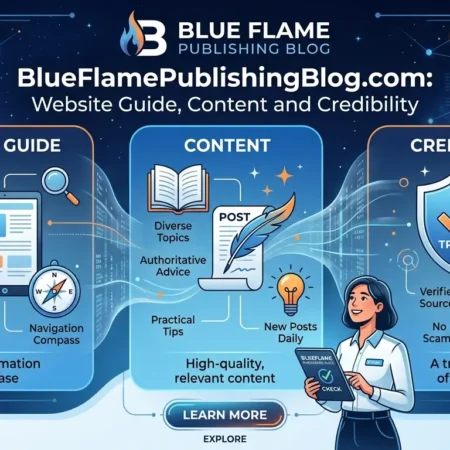
When people discover an unfamiliar website, they often want to know what it publishes, who it serves and whether its information is reliable. BlueFlamePublishingBlog.com is one such website. Its name suggests a focus on publishing and writing, but exploring the actual content provides a clearer picture of what readers may find.
The website describes itself as a source of articles about publishing, writing tips, digital content and creative growth. Its published material also covers broader subjects, including health, travel, technology and lifestyle topics. This makes it important to distinguish the site’s stated purpose from the full range of articles available on it.
This guide explains what BlueFlamePublishingBlog.com is, the types of content it features, how readers can assess its credibility and what writers or marketers should consider before treating it as a publishing opportunity.
Quick Answer: What Is BlueFlamePublishingBlog.com?
BlueFlamePublishingBlog.com is an online blog that publishes informational articles across multiple subjects. Although its name and description emphasise publishing, writing and creative content, its visible article selection includes broader general-interest topics.
Readers can explore its content to discover information and ideas, but they should assess each article individually for accuracy, author expertise, supporting evidence and relevance. The existence of a website or an article does not automatically establish that every claim is reliable.
1. What Is BlueFlamePublishingBlog.com?
BlueFlamePublishingBlog.com is an online content website that presents articles for readers interested in information, ideas and practical guidance. Its own description highlights publishing, writing tips, digital content and creative growth for authors and creators.
However, the site’s published articles extend beyond those subjects. Its visible content includes material about health and wellness, travel, technology and other general-interest topics. Consequently, readers should not assume that every article focuses on the publishing industry simply because of the domain name.
You can explore the website directly at BlueFlamePublishingBlog.com to see its current articles and available sections.
Understanding the website’s purpose
A website’s name, description and actual content can communicate slightly different things. The name BlueFlamePublishingBlog.com suggests a publishing-focused resource, while the broader range of articles gives it a general-interest character as well.
This distinction matters when deciding whether the website is suitable for a particular purpose. Someone looking for writing advice may find relevant material, while a reader seeking specialised publishing-industry guidance should check whether the specific article addresses that need.
The most useful approach is to evaluate individual pages instead of judging the entire website from its branding alone.
2. What Type of Content Does the Website Publish?
The website’s content covers several subjects. The exact selection may change as new articles are published, so readers should consult the live website for its latest offerings.
Writing and publishing-related content
Writing and digital publishing involve many activities, including developing ideas, researching subjects, structuring articles and presenting information clearly.
Readers interested in this area can look for material that helps them understand content creation, writing practices and online publishing. When an article offers advice, check whether it includes actionable examples and explains the reasoning behind its recommendations.
A useful writing resource should help readers improve their work rather than merely repeat general statements about producing quality content.
Health and wellness
The website also features health-related material, including topics associated with wellbeing and everyday health questions.
Health information deserves particular scrutiny because inaccurate advice can affect people’s decisions. Readers should look for qualified sources, relevant research and appropriate explanations of uncertainty.
For medical questions, consult recognised health authorities or a qualified healthcare professional rather than relying on a general-interest blog alone.
Travel and lifestyle
Travel articles can help readers discover destinations, consider trip-planning options and learn about different experiences. Lifestyle content may cover everyday interests, routines or activities.
The usefulness of these articles depends on their accuracy and freshness. Travel details such as transport schedules, entry requirements, prices and opening hours can change, so verify time-sensitive information before making plans.
Technology and other informational topics
Technology-related content may help readers explore digital tools, online platforms and emerging developments. Other general-interest articles can introduce unfamiliar concepts or provide background information.
For more technical subjects, look for product documentation, official announcements and other primary sources. An article is a useful starting point, but its claims should be checked when accuracy is important.
3. Who May Find the Website Useful?
BlueFlamePublishingBlog.com may appeal to different audiences depending on the article they are reading.
| Audience | Potential use |
|---|---|
| General readers | Discover information about unfamiliar subjects |
| Writers and bloggers | Explore writing-related ideas and content topics |
| Content marketers | Research article formats and approaches to online publishing |
| Travellers | Explore destination-related information and planning ideas |
| Technology readers | Learn introductory information about digital topics |
| Researchers | Find leads for further research, then verify claims independently |
These are potential uses, not a guarantee that every subject will be covered in sufficient depth.
Readers looking for introductory information
A broad blog can be a convenient starting point when a reader wants an introduction to a topic. An article may explain terminology, identify common questions or point towards subjects worth exploring further.
The next step is to check whether the information is supported by credible evidence. This is especially important when the topic involves health, finance, legal matters or other consequential decisions.
Writers and content creators
People who create online content can use articles as examples of how topics are presented to a general audience. They can examine headline clarity, paragraph structure, use of sources and the way a page answers its main question.
However, studying an article’s format is different from copying its text or assuming that its approach is effective for search performance. Good content should provide original value to its intended readers.
4. How to Navigate BlueFlamePublishingBlog.com
Exploring an unfamiliar website is easier when you follow a consistent process.
Step 1: Open the official website
Visit BlueFlamePublishingBlog.com directly. Check the domain spelling to avoid confusing it with similarly named websites.
Step 2: Browse the available sections
Look at the current navigation menu, category listings and recent articles. These elements can help you understand which subjects the website currently covers.
Menus and categories may change, so rely on what appears on the live site rather than assuming that an older description remains accurate.
Step 3: Choose an article relevant to your needs
Read the title and introduction to establish the article’s purpose. A clear title should indicate what the page covers and what readers can reasonably expect to learn.
Step 4: Review the article’s supporting information
Check for links to original research, official documentation, recognised organisations or other reliable references. Pay attention to the publication date when the subject changes frequently.
Step 5: Verify important claims
If an article makes a claim that affects a decision, confirm it using an authoritative source. This is particularly important for health recommendations, financial information, legal explanations and technical instructions.
Following these steps helps readers use the website as a research resource without treating every published statement as automatically verified.
5. Is BlueFlamePublishingBlog.com a Traditional Publisher?
The distinction between a blog and a traditional publishing company is important.
A traditional book publisher generally works with authors to develop and distribute books or other formal publications. Depending on its business model, it may provide editorial services, production, distribution, rights management and marketing.
A blog primarily publishes web-based articles. It may discuss writing or publishing without necessarily offering book publishing services.
BlueFlamePublishingBlog.com presents itself as a blog. Its name alone does not establish that it operates as a traditional publishing house, provides book contracts or offers professional publishing services.
What should authors check?
If you are an author looking for a publisher, investigate the specific services offered before submitting a manuscript or paying a fee.
Consider these questions:
- Does the organisation clearly explain its publishing services?
- Is the legal business identity available and verifiable?
- Are its contracts, pricing and service terms transparent?
- Does it explain who retains copyright and other publishing rights?
- Can you find credible information about books or authors it has worked with?
- Are its claims about distribution, sales or promotion supported by evidence?
These checks apply to any unfamiliar publishing business. A blog about publishing is not necessarily a company that publishes books.
6. How to Evaluate the Website’s Credibility
A website can look professional and still publish content that varies in quality. Credibility is best assessed by examining the article, the author and the evidence supporting the information.
Check the author’s background
Look for an author name and relevant qualifications or experience. A byline is more informative when it links to a profile explaining the writer’s expertise.
For specialist subjects, such as medicine or technical engineering, consider whether the writer has the knowledge required to explain the topic accurately.
Look for reliable references
Strong informational articles make it possible to check important claims. Depending on the subject, useful references may include government websites, academic research, official company documentation and recognised professional organisations.
A list of links is not enough by itself. Check whether those sources actually support the statements made in the article.
Check publication and update dates
Dates help readers judge whether information may be outdated. A recent publication date does not automatically make an article accurate, and an older article may still contain useful information if the subject has not changed.
For rapidly changing topics, verify details against current primary sources.
Distinguish facts from opinions
An article may contain facts, interpretations, recommendations and personal opinions. Reliable content makes these differences clear rather than presenting every statement as established fact.
For example, a writer’s opinion about a digital tool should not be confused with an independently verified performance result.
Review transparency and contact information
Look for accessible About, Contact, Privacy Policy and editorial information pages where appropriate. These details can help readers understand who operates the website and how it handles content.
The absence of one particular page does not by itself prove that a website is unreliable. Consider the wider evidence and the consequences of relying on its information.
Google’s guidance on creating helpful, reliable, people-first content provides further principles for evaluating useful and trustworthy online information.
7. Is BlueFlamePublishingBlog.com Suitable for Guest Posting?
Writers and marketers may come across BlueFlamePublishingBlog.com while researching websites for guest articles, brand exposure or content distribution.
Before treating it as a guest-posting opportunity, verify whether the site currently accepts outside contributions. The fact that a website publishes articles from multiple authors does not, by itself, confirm that it has an open submission process.
Check for official submission guidelines
Look for a current Write for Us page, contributor guidelines or an explicit invitation from the website. If none is available, use the site’s official contact channel to ask about its policy.
Do not assume that a third-party article describing a guest-post opportunity is accurate unless the website itself confirms it.
Evaluate topical relevance
A suitable publication should reach an audience that is likely to find your article useful.
For example, a detailed construction software guide would normally fit a publication focused on construction technology better than an unrelated lifestyle website. A broad publication may accept varied subjects, but the actual audience and editorial standards still matter.
Review the quality of published articles
Before submitting, examine several recent articles. Consider whether they provide original information, use trustworthy references, have meaningful author information and receive appropriate editorial attention.
A site that publishes content across many unrelated categories is not automatically unsuitable. Nevertheless, topical fit and editorial quality should be assessed rather than assumed.
Understand link policies
If your goal is to earn a backlink, review the website’s linking rules and the nature of the proposed placement.
Google’s spam policies caution against manipulative link-building practices. Paid links and other compensated placements should be handled using appropriate link attributes, such as rel="sponsored" where applicable. A guest article should primarily serve readers, not exist solely to influence search rankings.
Read Google Search Essentials before investing in a link-building arrangement.
8. SEO and Content Marketing Considerations
For website owners and marketers, a publication’s value should be assessed through more than its domain name or a claimed SEO metric.
Focus on audience relevance
A backlink is more meaningful when it appears in a context relevant to the linked page and helps readers discover useful information. A link from an unrelated article may provide little practical value to the intended audience.
Consider whether the publication’s readers are likely to visit your website, learn from the resource or find your business relevant.
Prioritise editorial quality
A well-prepared guest article should answer a genuine reader question, include accurate details and provide something beyond a rewritten version of existing search results.
Useful contributions may include original examples, expert commentary, a practical process or clearly explained research. The goal is to make the article worthwhile even for readers who never click an external link.
Avoid relying on domain metrics alone
Third-party SEO tools may estimate authority, traffic or backlink strength. These measurements can help with preliminary research, but they are not direct guarantees of rankings, referral traffic or business results.
Review the site’s real content, topical relevance, indexation and editorial practices. Where data is available, examine relevant organic traffic and the quality of its audience rather than relying on one score.
Keep links natural and useful
An external link should help the reader find additional information. Use descriptive anchor text that accurately represents the destination and avoid forcing exact-match keywords into every placement.
Google recommends creating helpful, people-first content and following its established search guidelines. Its SEO Starter Guide explains practical ways to make web content easier for search engines and people to understand.
9. Advantages and Limitations
BlueFlamePublishingBlog.com may be useful for general reading and initial research, but its value depends on the individual article and the reader’s objective.
Potential advantages
- Variety of subjects: Readers can explore multiple topics from one website.
- Accessible online content: Articles can introduce concepts without requiring specialist tools.
- Ideas for further research: A relevant article may point readers towards questions worth investigating.
- Writing and content examples: Writers can examine how online articles present information.
Limitations to keep in mind
- Topic depth may vary: A broad site may not provide the specialised detail required for every subject.
- Claims need verification: Readers should check important statements against reliable sources.
- Publishing services are not guaranteed: A publishing-related domain name does not prove that book publishing or guest-posting services are available.
- SEO value cannot be assumed: A site’s name, domain metrics or willingness to publish content does not guarantee a ranking benefit.
The best way to decide whether the website is useful is to compare its actual content with your needs.
Final Thoughts
BlueFlamePublishingBlog.com is worth examining as an online content resource, particularly for readers interested in writing, digital content and a range of general-interest subjects. Its publishing-related name should not be taken as proof that it is a traditional book publisher or that every article falls within a specialist publishing niche.
Readers can get more value from the website by checking the current content, assessing individual articles and verifying important claims through reliable sources. Writers and marketers should take the same careful approach before considering a submission or link-building opportunity.
Ultimately, a website’s usefulness depends on what it actually publishes, how well its articles support their claims and whether the information meets the reader’s needs.
What is BlueFlamePublishingBlog.com?
BlueFlamePublishingBlog.com is an online blog that describes its focus as publishing, writing tips, digital content and creative growth. Its visible content also covers broader general-interest subjects, so readers should review the current website to understand its latest coverage.
What topics does BlueFlamePublishingBlog.com cover?
Its published material includes writing and publishing-related subjects as well as broader areas such as health, travel, technology and lifestyle. The selection may change over time, so check the live site for current categories and articles.
Is BlueFlamePublishingBlog.com a legitimate book publisher?
The website presents itself as a blog, and its name alone does not establish that it operates as a traditional book publisher. Anyone considering publishing services should independently verify the organisation, its offerings, contracts and business identity.
Is the information on BlueFlamePublishingBlog.com reliable?
Reliability depends on the individual article. Check the author’s expertise, publication date, supporting references and consistency with authoritative sources. For important health, legal or financial matters, consult recognised specialist sources.
Can writers submit guest posts to BlueFlamePublishingBlog.com?
That should be confirmed through the website’s current submission guidelines or official contact channel. Do not assume that a site accepts guest posts simply because it publishes multiple articles or authors.

Other Articles
How to Use a Compass: Step-by-Step Instructions for Beginners.
No Comment! Be the first one.