

Introduction
Before contacting a potential client, investing in a business, selecting a supplier or analysing a competitor, it helps to understand the company behind the name. A website and a few search results may provide a basic overview, but they rarely answer every important question about a business’s operations, leadership, financial position, market presence and potential risks.
A research dossier for a target company brings this information together in one organised document. It combines verified facts, reliable source references and analytical insights to help researchers understand a business and make better-informed decisions.
For example, a sales professional might use a dossier to understand a prospect’s services, business priorities and likely needs before arranging a meeting. An investor may focus on financial statements, ownership and risk factors, while a marketing consultant may examine competitors, positioning, customer segments and online visibility.
The most valuable dossiers do more than collect information. They explain what the evidence means, identify gaps in available knowledge and distinguish confirmed facts from estimates or assumptions.
This guide explains how to create a target company research dossier, what sections to include, where to find reliable information, how to analyse competitors and risks, and how to use a practical template for different business objectives.
Quick Answer: What Is a Research Dossier for a Target Company?
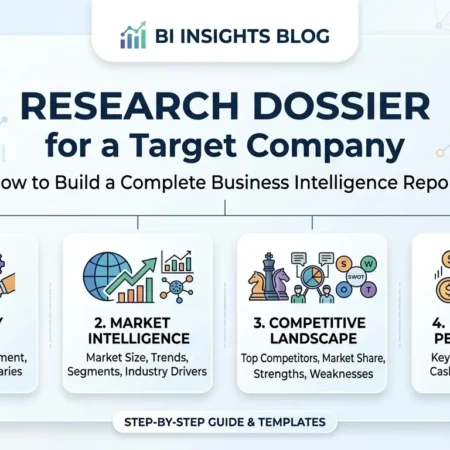
A research dossier for a target company is a structured report containing relevant information, supporting evidence and analysis about a specific business. It helps a researcher understand what the company does, how it operates, who it serves, how it competes and which opportunities or risks deserve attention.
| Element | What it covers |
|---|---|
| Company profile | Name, location, history, ownership and industry |
| Products and services | Main offerings, customers and business model |
| Leadership | Founders, executives and organisational structure |
| Financial information | Revenue, profitability, funding and financial risks where available |
| Market analysis | Industry conditions, target audiences and market position |
| Competitor research | Direct competitors, indirect alternatives and differentiation |
| Reputation | Customer feedback, public statements and relevant media coverage |
| Risk assessment | Operational, financial, regulatory and reputational concerns |
| Evidence log | Sources, dates, confidence levels and verification notes |
| Final assessment | Key findings, unanswered questions and recommended next steps |
The appropriate depth depends on the objective. A dossier for sales prospecting will differ from one prepared for an acquisition, investment decision or supplier evaluation.
1. What Is a Research Dossier for a Target Company?
A research dossier is an organised collection of information about a business, prepared to answer a specific set of research questions.
The phrase target company simply means the organisation being investigated. It could be a potential customer, employer, supplier, business partner, competitor, investment opportunity or acquisition candidate. It does not necessarily refer to Target Corporation, the American retail company.
A basic company profile usually describes the organisation. A research dossier goes further by evaluating evidence, comparing relevant information and identifying factors that may influence a business decision.
For instance, a company profile might state that a software provider sells subscription-based products. A more comprehensive dossier would investigate its pricing structure, target customers, competitors, recent product announcements, customer feedback and available financial information.
Company profile vs research dossier vs due diligence report
These terms overlap, but their purposes are different.
| Document | Primary purpose | Typical depth |
|---|---|---|
| Company profile | Describe a business and its main activities | Basic overview |
| Research dossier | Organise evidence and analyse a company for a defined objective | Moderate to detailed |
| Due diligence report | Investigate specific risks and verify information before a significant transaction or commitment | Depends on the transaction, often highly detailed |
A research dossier may support due diligence, but it is not automatically a substitute for legal, financial, tax or technical due diligence carried out by qualified professionals.
What makes a dossier useful?
A strong dossier answers three questions:
- What do we know about the company?
- What evidence supports that information?
- What does the evidence mean for the decision being considered?
Keeping these questions in view prevents the document from becoming a collection of unrelated facts.
2. Why Is a Company Research Dossier Important?
Online company research can quickly become disorganised. One source may contain leadership information, another may provide financial figures, and a third may discuss a recent product launch. Without a structured approach, it is easy to lose track of publication dates, overlook contradictory claims or confuse an estimate with a verified fact.
A research dossier provides a central reference point.
Make better-informed business decisions
A company may appear attractive because of its product range or public reputation. However, additional research may reveal limitations in its service coverage, dependence on a narrow customer base or changes in its business strategy.
Organised research helps decision-makers evaluate the full picture rather than relying on one positive or negative signal.
Prepare for sales and business development
Sales professionals can research a prospective customer before reaching out. Understanding the company’s products, audience, market, recent announcements and possible challenges can make conversations more relevant.
A dossier can also help teams prioritise prospects instead of spending the same amount of time on every company.
Understand competitors
Businesses can use dossiers to compare product offerings, pricing approaches, positioning, customer segments and public messaging. The findings can inform differentiation and marketing strategy without relying on guesswork.
Reduce avoidable risks
A supplier assessment, partnership discussion or investment opportunity may require closer examination of ownership, reputation, operating history and financial disclosures.
A dossier helps identify areas requiring further verification. It does not guarantee that every risk will be discovered, particularly when information is unavailable or deliberately concealed.
Save time on repeat research
A well-maintained dossier can be updated as new information becomes available. Researchers do not need to rebuild the document from scratch every time a meeting, campaign or decision arises.
3. What Should a Target Company Research Dossier Include?
The sections should reflect the research objective, but a comprehensive dossier usually includes the following components.
Company identity and background
Record the company’s official name, website, registered location where relevant, industry, founding history and operating markets.
Verify that you have identified the correct legal entity. Businesses can have similar names, subsidiaries, trading names or separate operations in different countries.
Products, services and business model
Identify the company’s main offerings, intended customers, distribution channels and pricing approach where information is available.
Try to understand how the business creates value and generates revenue. For a subscription software company, that might involve recurring subscriptions. A manufacturer may sell through distributors, direct sales or a combination of channels.
Do not infer the complete business model from a short marketing description. Use official product information, disclosures and credible independent sources where possible.
Leadership and ownership
Record founders, senior executives, board members and parent-company relationships when these details are relevant and publicly available.
Leadership information can help explain decision-making structures, while ownership information may clarify whether a business is independently owned, publicly listed or part of a larger group.
For significant transactions, confirm legal ownership through appropriate official records rather than relying solely on a company biography.
Financial and operational information
For public companies, financial statements and regulatory filings can provide useful information about revenue, expenses, profitability, assets, liabilities and risk factors.
The US Securities and Exchange Commission’s EDGAR database provides public access to company filings, including annual and quarterly reports. Its Investor.gov guidance explains how these documents can support company research.
For private companies, comparable information may be limited. If figures come from a third-party estimate, label them as estimates rather than verified company disclosures.
Operational information may include locations, service coverage, distribution arrangements, manufacturing capacity or other details that are relevant to the business under investigation.
Customers and target markets
Identify the customer groups the company serves and the problems its products or services aim to solve.
Potential sources include product pages, customer case studies, published testimonials, annual reports and industry coverage. Treat company-published success stories as useful evidence of what the company claims, not automatic proof of typical customer outcomes.
Competitors and market position
Identify direct competitors offering similar products to similar customers. Then consider indirect competitors that solve the same problem through a different approach.
Compare relevant factors such as product features, pricing, service coverage, target audience, distribution and positioning. Avoid declaring a company a market leader unless credible evidence supports that description.
Reputation and recent developments
Review relevant announcements, customer feedback, independent reporting, product releases, acquisitions, leadership changes and other developments.
Use dates and source references. An old article may describe a situation that has since changed, while a single customer review may not represent the wider customer experience.
Risks, opportunities and unanswered questions
Summarise the most important concerns and possible growth opportunities identified during research. Record the evidence supporting each assessment and note what remains uncertain.
This section helps convert the dossier from a reference document into a tool for decision-making.
4. How to Create a Research Dossier Step by Step
A consistent workflow improves accuracy and makes research easier to repeat.
Step 1: Define the research objective
Start by explaining why you are investigating the company.
Examples include:
- Qualifying a potential B2B customer
- Comparing a competitor’s market positioning
- Assessing a prospective supplier
- Preparing for a job interview
- Evaluating a potential investment
- Supporting an acquisition or partnership discussion
The objective determines which questions matter most. A marketing consultant does not need to investigate every detail that an acquisition adviser would require.
Write down the main questions before collecting data.
Step 2: Confirm the company’s identity
Find the official website and confirm the company’s name, location and business activities.
If several organisations share similar names, use additional identifiers such as the registered entity name, country, official domain or registration number where appropriate.
This simple step helps prevent a common research error: combining information from different businesses into one report.
Step 3: Gather information from primary sources
Start with sources closest to the original information.
These may include:
- Official company websites and product pages
- Annual reports and regulatory filings
- Investor relations announcements
- Government company registries
- Official press releases
- Published financial statements
- Regulatory notices and court records, where relevant
Primary sources are particularly useful for confirming what a company has formally disclosed. They still need interpretation, and a company’s marketing claims should not automatically be treated as independent assessments.
Step 4: Add independent sources
Use reputable news organisations, industry publications, research reports and relevant professional commentary to provide context.
Independent sources can help test company claims, explain market developments and identify competing interpretations.
For important claims, seek corroboration from more than one reliable source. If sources disagree, record the disagreement rather than selecting whichever statement best fits your expectations.
Step 5: Organise the findings
Place each fact or observation in the appropriate dossier section. Record the source, publication date, date accessed and any limitations.
A spreadsheet can work well for source tracking, while a document is often better for the executive summary and analysis. Larger projects may benefit from a research database or shared knowledge system.
Step 6: Analyse rather than merely collect
Ask what each finding means for your objective.
For example, knowing that a company operates in several countries is a fact. Whether that geographic reach provides a competitive advantage depends on additional evidence about customers, costs, local competition and operational capabilities.
Use clear labels to distinguish verified information, third-party estimates and your own analysis.
Step 7: Assess the most important risks
Identify issues that could materially affect the decision. The relevant risks may involve finances, operations, reputation, regulation, technology or dependence on particular suppliers and customers.
Assign priorities based on evidence, potential impact and uncertainty. Avoid presenting a speculative concern as a confirmed problem.
Step 8: Write the executive summary
Summarise the most important findings, strengths, risks, opportunities and outstanding questions.
Although the summary appears near the beginning of the final report, it is often easier to write it after completing the research.
A decision-maker should be able to understand the central findings without reading every source note.
Step 9: Verify and update the dossier
Before sharing the document, check important names, dates, figures, source links and calculations. Confirm that the evidence supports the wording of each conclusion.
Set a review date based on the purpose of the dossier. A sales prospect profile may need an update before a major outreach campaign, while an investment or acquisition assessment may require much more frequent verification.
5. Where to Find Reliable Company Information
No single source provides a complete picture of every business. Use a combination of sources and match each one to the information you need.
| Information required | Useful sources | Important consideration |
|---|---|---|
| Company overview | Official website, company profile, annual report | Marketing descriptions may emphasise strengths |
| Financial performance | Regulatory filings, audited accounts, investor relations | Confirm the reporting period and accounting basis |
| Leadership | Official leadership pages, annual reports, regulatory disclosures | Check whether appointments are current |
| Legal identity | Relevant government business registry | Match the correct legal entity and jurisdiction |
| Products and pricing | Official product and pricing pages | Pricing can change or vary by customer |
| Competitor activity | Competitor websites, product documentation, industry reporting | Compare equivalent offerings |
| Customer sentiment | Review platforms, customer forums, published case studies | Individual reviews may be unrepresentative |
| Recent developments | Official announcements and reputable news coverage | Check publication dates and original sources |
| Industry trends | Government statistics, trade associations, credible research | Understand methodology and coverage |
Researching public companies
Publicly listed companies often disclose financial and governance information through regulators and investor relations websites.
For US reporting companies, SEC EDGAR allows users to search filings by company name or ticker. Annual reports can contain audited financial statements, management discussion and risk factors, while quarterly reports provide updates for the relevant period.
Read the original filings when a decision depends on a financial figure. News summaries are useful for context but may omit important qualifications.
Researching private companies
Private businesses may not publish the same level of financial information as listed companies. Researchers can use official registries, company announcements, credible news coverage, available accounts and direct information supplied with permission.
Do not assume that a missing financial figure means the company has no revenue or that an estimated figure is accurate. Clearly record what is known, what is estimated and what could not be verified.
Evaluating source reliability
Consider the source’s authority, proximity to the original information, publication date, methodology and possible conflicts of interest.
An official filing may be authoritative for reported financial results, while an independent industry report may be more useful for understanding market trends. A customer review may provide a useful account of an individual experience, but it cannot establish a company’s overall performance by itself.
6. How to Analyse Competitors and Market Position
Competitor research helps explain where the target company fits within its market and how it may differentiate itself.
Identify direct and indirect competitors
Direct competitors usually offer similar products or services to similar customer groups. Indirect competitors address the same customer need using different products, delivery methods or business models.
For example, a project management software company may compete directly with other project management platforms. Its indirect competition could include general collaboration tools or manual workflows that customers use instead.
Build a comparison table
Choose criteria that matter to the research objective and apply them consistently.
| Comparison factor | Target company | Competitor A | Competitor B |
|---|---|---|---|
| Core offering | Research finding | Research finding | Research finding |
| Target customers | Research finding | Research finding | Research finding |
| Pricing model | Verified or labelled estimate | Verified or labelled estimate | Verified or labelled estimate |
| Geographic coverage | Research finding | Research finding | Research finding |
| Main differentiator | Evidence-based analysis | Evidence-based analysis | Evidence-based analysis |
| Potential weakness | Evidence-based assessment | Evidence-based assessment | Evidence-based assessment |
| Supporting sources | Source links | Source links | Source links |
Use consistent definitions. For example, do not compare one company’s enterprise pricing with another company’s entry-level plan without explaining the difference.
Identify opportunities and gaps
Look for customer needs that competitors appear to address poorly, underserved segments, differences in service models or product features that may matter to buyers.
These observations are hypotheses until supported by evidence. Customer interviews, market research, product testing and sales feedback can help determine whether an apparent gap represents a genuine opportunity.
Avoid unsupported market-share claims
A company’s popularity on social media, search visibility or number of employees does not establish its market share. Market-share estimates require a defined market, a relevant period, comparable data and a clear methodology.
If reliable figures are unavailable, describe the company’s observable position without assigning a numerical ranking.
7. How to Assess Company Risks
A research dossier should identify risks relevant to its purpose rather than attempt to list every imaginable problem.
Financial risk
Examine available information about profitability, cash flow, debt, liquidity, funding and dependence on external financing. Compare figures across consistent reporting periods.
For private businesses, note the limitations of any financial assessment when audited statements or detailed disclosures are unavailable.
Operational risk
Consider supply-chain dependencies, service reliability, geographic concentration, staffing challenges and reliance on critical technology or third parties.
The relevant issues will differ between a software company, manufacturer, retailer and professional services business.
Market and competitive risk
Evaluate changing customer preferences, new competitors, pricing pressure, substitute products and industry developments.
A strong current position does not guarantee future success. Equally, the presence of competition does not prove that a company is struggling.
Legal and regulatory risk
Depending on the industry and jurisdiction, relevant issues may include licences, regulatory obligations, intellectual property disputes, litigation or data protection requirements.
Use official records and reputable reporting where possible. Legal claims should be described carefully, with the procedural status and relevant dates included. An allegation is not the same as a finding of wrongdoing.
Reputational risk
Review relevant customer complaints, product controversies and credible reporting. Look for patterns and corroboration rather than drawing broad conclusions from isolated comments.
Record uncertainty explicitly
A practical risk register can include:
| Risk or concern | Evidence | Potential impact | Confidence | Next step |
|---|---|---|---|---|
| Example: supplier concentration | Public disclosure or verified information | Possible disruption | Medium | Seek further confirmation |
| Example: unclear pricing | Incomplete public information | Difficult comparison | High confidence that data is missing | Request a formal quote |
| Example: negative customer feedback | Multiple relevant sources | Possible reputation concern | Requires evaluation | Investigate pattern and context |
The examples above are illustrative, not claims about a particular company.
8. Practical Target Company Research Dossier Template
The following template can be copied into a document or spreadsheet and adapted to your project.
Section A: Research objective
- Target company: [Enter company name]
- Official website: [Enter verified URL]
- Research date: [Enter date]
- Researcher or team: [Enter name or team]
- Primary objective: [Explain why the research is being conducted]
- Key questions: [List the questions the dossier must answer]
- Intended audience: [Sales team, management, investor, researcher or other audience]
Section B: Executive summary
- Company overview: [Brief description]
- Most important findings: [Summarise the main discoveries]
- Key strengths: [List supported strengths]
- Key risks: [List evidence-based concerns]
- Potential opportunities: [Explain relevant possibilities]
- Information gaps: [List unresolved questions]
- Overall assessment: [Provide a balanced conclusion]
Section C: Company profile
- Legal name: [Name]
- Trading or brand name: [Name, if different]
- Industry: [Industry]
- Founded: [Verified year, if available]
- Headquarters: [Verified location]
- Ownership: [Public, private, subsidiary or other]
- Parent company: [If applicable]
- Main products or services: [List]
- Main customer groups: [List]
- Geographic markets: [List]
- Official sources: [Links]
Section D: Business and market analysis
- Business model: [How the company creates value and earns revenue]
- Main revenue sources: [Verified data or clearly labelled estimates]
- Target customers: [Customer segments]
- Main competitors: [Names and evidence]
- Differentiators: [Supported findings]
- Market opportunities: [Evidence and analysis]
- Market risks: [Evidence and analysis]
Section E: Financial and operational review
- Revenue and reporting period: [Figure and source, if available]
- Profitability: [Figure and source, if available]
- Funding or ownership changes: [Verified details]
- Workforce information: [Figure, source and date, if available]
- Operational footprint: [Locations or service coverage]
- Key dependencies: [Known dependencies]
- Data limitations: [Missing or uncertain information]
Section F: Risk register
- Risk or concern: [Description]
- Evidence: [Source and date]
- Potential impact: [Explain]
- Likelihood assessment: [Only where evidence supports it]
- Confidence level: [High, medium or low, with explanation]
- Follow-up action: [What needs verification]
Section G: Evidence log
| Claim or data point | Source | Publication date | Access date | Status |
|---|---|---|---|---|
| Company founding year | Official company source | [Date] | [Date] | Verified |
| Financial result | Official filing or accounts | [Date] | [Date] | Verified for stated period |
| Market-share estimate | Credible third-party report | [Date] | [Date] | Estimate |
| Competitive advantage | Multiple sources | [Dates] | [Date] | Analysis |
Replace the example entries with actual research before publishing or using the dossier for a business decision.
Section H: Recommendations and next steps
- What has the research established?
- Which questions remain unanswered?
- What information needs direct confirmation?
- Which risks require specialist review?
- What action should be taken next?
- When should the dossier be updated?
This template creates a consistent starting point. Expand or remove sections according to the objective instead of treating every field as mandatory.
9. Common Research Mistakes to Avoid
Even a detailed report can be misleading if the research process is weak.
Relying only on the company website
An official website is valuable for understanding a company’s own descriptions, offerings and announcements. It may not provide an independent assessment of performance or competitive position.
Better approach: Combine official material with relevant filings, independent reporting and other credible evidence.
Using outdated information
Executives change roles, products are discontinued, prices are revised and businesses are acquired. An old article may no longer describe the current situation.
Better approach: Record dates, verify important facts again before use and identify the period covered by each financial figure.
Mixing facts with assumptions
A researcher might interpret a new office opening as proof of strong financial performance. That conclusion may be possible, but the announcement alone does not establish it.
Better approach: Label facts, estimates and interpretations separately.
Treating estimates as confirmed numbers
Private-company revenue, employee counts and market-share figures may come from third-party estimates or incomplete datasets.
Better approach: State the source, methodology where available and confidence level. If a figure cannot be verified, say so.
Ignoring contradictory evidence
A report that includes only information supporting the researcher’s initial opinion may create a distorted picture.
Better approach: Look for evidence that challenges your assumptions and explain meaningful disagreements between sources.
Collecting information without a clear purpose
A lengthy dossier can still be ineffective if it does not answer the original research question.
Better approach: Prioritise information according to the intended decision and place minor details in supporting notes.
Overlooking privacy and legal boundaries
Business research should use appropriate sources and respect privacy, access restrictions and applicable laws. Do not obtain confidential information through deception, unauthorised access or improper collection methods.
Better approach: Keep the research focused on legitimate business purposes and consult qualified professionals when the project involves sensitive legal, financial or regulatory questions.
10. Who Can Benefit from a Company Research Dossier?
A well-structured dossier can support different professional roles, although each role will prioritise different information.
Sales and business development teams
These teams can research prospects, identify relevant decision-makers through appropriate public sources, understand likely business needs and prepare more relevant outreach.
Marketing professionals
Marketers can analyse competitors’ offerings, positioning, messaging, target customers and content strategy. The findings can help identify potential differentiation and areas for further market research.
Investors and financial analysts
A dossier can organise company disclosures, financial performance, ownership information and risk factors. Investment decisions may require additional valuation work and professional advice; a dossier alone is not enough to determine whether a security is suitable.
Consultants and business advisers
Consultants can use dossiers to understand a client’s industry, operating model and competitive environment before developing recommendations.
Recruiters and job seekers
People preparing for interviews can investigate a prospective employer’s products, public strategy, leadership and recent developments. This supports more informed questions during interviews.
Procurement and supplier management teams
These teams can organise available information about suppliers, operating capabilities, reputation and potential dependencies. Formal supplier approval may still require references, contractual checks, security assessments or other verification.
Students and researchers
A dossier can help structure an academic company study and distinguish original company disclosures from third-party analysis. Students should follow their institution’s rules for citations, research integrity and the use of sources.
11. Final Thoughts
A research dossier for a target company is most useful when it turns scattered information into a clear, evidence-based view of a business. It helps researchers understand what a company does, how it competes, what is publicly known about its performance and which issues deserve further investigation.
The best approach is to start with a defined objective, use reliable sources, record publication dates and maintain a clear distinction between verified facts, third-party estimates and personal analysis. Competitor comparisons and risk assessments should be based on relevant evidence rather than assumptions.
Use the template in this guide as a practical starting point, then adapt it to your specific task. A sales prospect dossier, competitor analysis and investment assessment will not require exactly the same information.
Finally, treat the dossier as a working document rather than a one-time report. Update it when meaningful information changes, record unresolved questions and verify important claims before relying on them. A well-maintained dossier can support more thoughtful business decisions without pretending to remove every uncertainty.
What is a research dossier for a target company?
It is a structured report that organises verified information and analysis about a specific business. It can cover company background, products, leadership, financial information, competitors, market position, risks and supporting evidence.
What is the difference between a company profile and a research dossier?
A company profile mainly describes a business. A research dossier goes further by evaluating evidence, comparing the company with relevant alternatives, identifying risks and answering specific research questions.
How do I create a target company research dossier?
Start with a clear objective, confirm the correct company identity, gather primary and independent sources, organise findings into relevant sections, analyse competitors and risks, record evidence, and verify the final conclusions.
What sources are best for company research?
Useful sources include official company websites, annual reports, regulatory filings, government registries, investor relations pages, reputable news organisations and relevant industry research. The best source depends on the claim being checked and the company’s jurisdiction.
Can a research dossier help with competitor analysis?
Yes. It can organise comparable information about competitors’ products, customers, pricing, distribution and positioning. Consistent comparison criteria and reliable evidence are essential for useful conclusions.



No Comment! Be the first one.