

Introduction
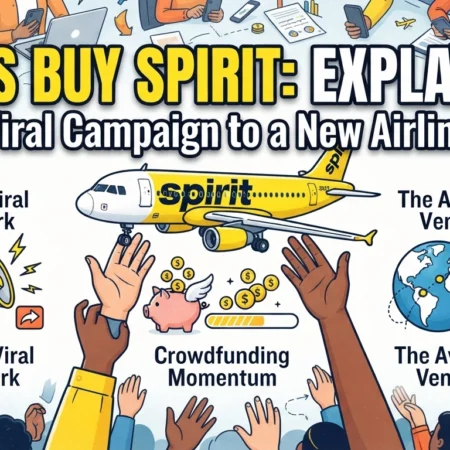
Let’s Buy Spirit became one of the most unusual airline stories of 2026 after Spirit Airlines abruptly ended its operations and a social-media campaign proposed buying the failed carrier through public pledges. What started with a viral idea from voice actor and content creator Hunter Peterson quickly developed into a large online movement, with supporters expressing interest in contributing money toward a community-owned airline.
The important part of the story, however, is that Let’s Buy Spirit was not a completed acquisition of Spirit Airlines. The original campaign collected non-binding pledges rather than completing a purchase, and by August 2026 the initiative had reportedly shifted toward building a new airline rather than acquiring Spirit’s remaining assets.
For anyone searching “Lets Buy Spirit,” “letsbuyspirit.com,” or “Let’s Buy Spirit Airlines,” understanding that distinction is essential.
Quick Answer: What Was Let’s Buy Spirit?
Let’s Buy Spirit was a viral crowdfunding and community-ownership campaign created after Spirit Airlines announced an immediate wind-down of its operations on May 2, 2026.
The concept was simple: large numbers of ordinary travelers would pledge relatively small amounts of money with the goal of collectively acquiring or rebuilding an airline associated with Spirit’s low-cost model.
The original proposal gained attention on TikTok and other social platforms. According to contemporary reports, the campaign’s website recorded millions of dollars in non-binding pledges within its first few days.
By August 2026, reporting indicated that the project had moved away from purchasing Spirit’s remaining assets and was instead pursuing a new-airline concept under the name Let’s Build An Airline.
Key Facts at a Glance
| Question | Answer |
|---|---|
| What was Let’s Buy Spirit? | A viral community crowdfunding/pledge campaign |
| What airline was targeted? | Spirit Airlines |
| Who launched the idea? | Hunter Peterson |
| When did it become viral? | Early May 2026 |
| Was Spirit successfully purchased? | No |
| Were the original pledges the same as collected investment capital? | No |
| What happened to Spirit Airlines? | It began an orderly wind-down on May 2, 2026 |
| What happened to the campaign? | It reportedly shifted toward creating a new airline |
| What was the later name? | Let’s Build An Airline |
| Was the original campaign a normal airline ticketing site? | No |
What Is Let’s Buy Spirit?
Let’s Buy Spirit was an online movement built around the idea that everyday travelers could collectively help acquire or recreate Spirit Airlines after the carrier stopped operating.
The concept emerged shortly after Spirit’s May 2, 2026 shutdown. Hunter Peterson proposed that a large number of people could each contribute an amount comparable to the cost of a typical Spirit ticket. The idea quickly spread through TikTok, Instagram, news sites, and online communities.
Instead of approaching the idea as a traditional airline acquisition funded by one corporation or a small group of investors, the campaign emphasized community ownership.
That distinction became one of the most interesting parts of the story.
The movement was effectively asking:
Could thousands or millions of ordinary travelers collectively support a new airline?
At first, the answer was framed around buying Spirit. Later developments moved the concept toward creating an airline from the ground up.
Why Did the Let’s Buy Spirit Campaign Start?
The campaign appeared immediately after a major disruption in the U.S. airline market.
On May 2, 2026, Spirit Airlines announced that it had begun an orderly wind-down of operations. The company canceled all flights and told customers not to go to the airport. Spirit attributed the decision to worsening financial conditions, including sharply higher oil prices and the lack of additional funding.
The shutdown created an unusual opening for discussion.
Spirit had been known for an ultra-low-cost business model and had served millions of travelers looking for inexpensive airfares. Its sudden disappearance left customers, employees, airports, and other industry participants dealing with the consequences.
Peterson’s proposal took that moment and turned it into a social-media question:
What if travelers themselves tried to bring the airline back?
Reports said the initial concept involved asking supporters to pledge approximately the cost of a Spirit ticket.
The idea was intentionally simple enough to understand in a short social-media video.
What Happened to Spirit Airlines?
Understanding the campaign requires understanding what happened to Spirit itself.
Spirit Airlines announced on May 2, 2026, that it was immediately winding down operations. Its official restructuring website states that all flights were canceled and that regular customer service was no longer available.
The company’s announcement followed years of financial difficulties and restructuring efforts.
The carrier had previously entered bankruptcy proceedings and had attempted to find ways to strengthen its financial position. Spirit ultimately said rising oil prices and other pressures had significantly damaged its financial outlook, while additional funding was unavailable.
The shutdown was therefore not simply a case of an airline deciding to stop serving a particular route.
It was an orderly wind-down of the airline’s operations.
That distinction created a significant challenge for anyone hoping to “buy Spirit.”
How Did the Let’s Buy Spirit Crowdfunding Idea Work?
The campaign’s basic model was based on pledges.
A person could indicate that they were willing to contribute a specified amount if the project progressed.
That is different from purchasing shares in a publicly traded company or transferring money into a completed acquisition fund.
Early reports emphasized that the pledges were non-binding. One report covering the campaign stated that more than 36,000 people had registered pledges totaling approximately $22.8 million during the early stage, while noting that no money had actually been collected at that point.
The campaign later reported substantially larger pledge totals as public interest grew.
Some media reports cited approximately $88 million in pledges and more than 124,000 participants, while other reports published different totals as the campaign evolved. These figures should therefore be treated as campaign-reported or contemporaneous media figures rather than audited investment capital.
That distinction matters when evaluating viral crowdfunding stories.
Pledge vs. Investment
A pledge generally represents an expression of intended support.
An investment or completed contribution involves a financial transaction governed by specific terms and applicable laws.
Those concepts should not be treated as interchangeable.
How Much Money Was Pledged?
The reported figure changed rapidly during the campaign’s initial viral period.
Early coverage reported approximately $22.8 million in non-binding pledges from more than 37,000 supporters.
Other reports subsequently described totals of approximately $88 million and more than 124,000 participants.
Later articles reported still higher figures.
Because these numbers were changing quickly and were based largely on the campaign’s own pledge system, they should not be interpreted as equivalent to cash raised or verified investment assets.
A useful way to describe the situation is:
Millions of dollars were pledged, but pledges were not the same thing as money raised to purchase an airline.
That difference became increasingly important as the project confronted the practical challenges of acquiring or restarting an airline.
Was Let’s Buy Spirit Actually Buying Spirit Airlines?
No completed acquisition of Spirit Airlines resulted from the campaign.
Spirit’s own restructuring materials state that the company had begun an orderly wind-down of operations in May 2026.
The campaign also faced a fundamental issue: buying a company that has entered a liquidation or wind-down process is very different from buying a healthy operating business.
Aircraft, airport slots, leases, intellectual property, contracts, employees, maintenance arrangements, regulatory approvals, and other assets can all be handled separately during a wind-down.
A group attempting to restart an airline would therefore need far more than a large pledge total.
It would need a viable corporate structure, substantial financing, regulatory approvals, aircraft access, airport arrangements, operating personnel, safety systems, maintenance infrastructure, insurance, technology, and a sustainable business plan.
Why Was Buying an Airline So Complicated?
Airlines are among the most operationally complex businesses to restart.
A company cannot simply purchase aircraft and begin selling tickets.
Regulatory Requirements
Commercial airlines operate under extensive aviation regulations.
A new or restarted carrier needs the appropriate regulatory approvals and operating authority before transporting passengers commercially.
Aircraft
An airline needs access to aircraft through ownership, leasing, or another arrangement.
Aircraft also require maintenance programs, crews, spare parts, inspections, and continuing airworthiness management.
Airport Access
Airlines need airport gates, slots where applicable, terminal arrangements, ground handling, and other infrastructure.
Those relationships cannot necessarily be transferred automatically from a failed airline to a new company.
Employees
Pilots, flight attendants, mechanics, dispatchers, customer-service personnel, engineers, and operational managers are all critical.
A restart would require recruiting or rehiring qualified workers and rebuilding operational teams.
Capital
Aircraft and airport operations require substantial capital.
Fuel, labor, maintenance, aircraft leases, insurance, technology, airport charges, and regulatory compliance create significant ongoing expenses.
For these reasons, a large online pledge total alone would not automatically make an airline acquisition or restart feasible.
What Happened to the Let’s Buy Spirit Website?
The original website attracted unusually high traffic during the campaign’s first days.
News reports said the site experienced technical problems and temporarily went offline as interest surged.
The campaign subsequently directed supporters toward updated online channels as it developed.
There is also an important safety consideration here.
During the viral period, multiple websites and social-media references appeared around the “Buy Spirit” concept. Users should not assume that every domain containing the words Spirit, Buy, or Let’s Buy Spirit belongs to the campaign.
A domain name by itself does not establish ownership or legitimacy.
Is LetsBuySpirit.com Still Relevant?
The domain became closely associated with the original campaign, but the project’s purpose changed over time.
A domain-monitoring page updated in August 2026 still identified letsbuyspiritair.com with the “Spirit 2.0” concept.
However, reporting published on August 23, 2026, said the initiative had moved away from acquiring Spirit Airlines’ assets and had rebranded toward Let’s Build An Airline.
That means people researching the phrase today should pay attention to the date of the information they find.
An article published in early May may describe a campaign whose goals were materially different from those reported in August.
Let’s Buy Spirit vs. Let’s Build An Airline
The evolution of the campaign can be summarized like this:
| Stage | Main Concept |
|---|---|
| Initial idea | Publicly pledge money toward buying Spirit |
| Early campaign | Build a large community of supporters |
| Viral period | Generate millions of dollars in non-binding pledges |
| Acquisition challenge | Deal with Spirit’s wind-down and asset/liquidation process |
| Later development | Shift focus away from acquiring Spirit |
| Reported August direction | Develop a new airline concept |
According to August reporting, the project became Let’s Build An Airline, with a proposed membership-style airline model rather than a direct purchase of Spirit Airlines.
That is an important update for anyone searching for current information.
Calling the August project simply a plan to “buy Spirit Airlines” would leave out a major development.
Safety and Legitimacy: What Users Should Know
The Let’s Buy Spirit story also generated questions about whether websites associated with the movement were legitimate.
Third-party website-reputation services produced warnings about at least one domain using the campaign’s name. ScamAdviser, for example, gave letsbuyspirit.com a very low trust assessment and cited signals including the domain’s young age and reports associated with phishing.
Another security-analysis service also reported a low reputation score and noted that the domain was newly registered.
Those automated assessments should not automatically be treated as proof that the campaign itself was fraudulent. Website-reputation systems can identify technical or risk signals without determining the complete legal or organizational status of a project.
The practical lesson is more straightforward:
Do not send money simply because a website looks professional.
Before providing payment information, verify:
- Who operates the website
- Whether the organization is legally identified
- What entity receives the money
- Whether contributions are refundable
- Whether the money is a pledge or an actual investment
- What legal rights contributors receive
- What happens if the project fails
- Whether official social channels identify the same domain
- Whether independent reporting confirms the current status
Anyone encountering a newer “buy Spirit” investment page should perform those checks independently.
Why Did Let’s Buy Spirit Attract So Much Attention?
Several factors came together at the same time.
The Spirit Brand Was Well Known
Spirit had a recognizable position in the U.S. airline market.
Its ultra-low-cost model attracted travelers who prioritized inexpensive base fares.
The Shutdown Was Sudden
Spirit announced an immediate wind-down on May 2, 2026, with flights canceled and customers told not to go to airports.
That created a dramatic news environment.
The Idea Was Easy to Understand
The campaign did not begin with a complicated corporate presentation.
Instead, the pitch was essentially:
What if lots of ordinary travelers contributed a relatively small amount and collectively owned an airline?
That made the concept highly shareable.
Social Media Accelerated It
TikTok and other platforms allowed the idea to reach large audiences within hours.
Reports described millions of views and rapidly increasing supporter numbers during the campaign’s early period.
What the Story Says About Community-Owned Businesses
The campaign introduced a broader question about alternative ownership structures.
Community ownership can take different forms, including cooperatives, membership organizations, employee ownership, and other structures.
The idea is not completely unfamiliar in American business.
The Green Bay Packers, for example, have a widely discussed community-ownership structure, although an airline would operate under a very different regulatory and financial environment.
An airline built around members would still need to solve the fundamental problems of aviation economics.
Cheap fares must coexist with fuel expenses, labor costs, maintenance, aircraft financing, airport fees, insurance, technology, and regulatory requirements.
The interesting part of the Let’s Buy Spirit story is therefore not only whether Spirit could be purchased.
It is also whether a large online community could translate enthusiasm into a sustainable transportation business.
What Can Businesses and Entrepreneurs Learn From the Campaign?
The Let’s Buy Spirit story provides several useful lessons about online business campaigns.
1. A Simple Idea Can Spread Quickly
The campaign used an easy-to-understand concept that required little explanation.
That made it suitable for short-form video.
2. Viral Attention Is Not the Same as Revenue
Millions of views can generate awareness.
They do not automatically produce legally committed capital, paying customers, or a sustainable business.
3. Pledges Need Structure
A serious crowdfunding project needs clear terms.
Participants should know whether they are making donations, purchasing memberships, investing, or simply registering interest.
4. Trust Requires Transparency
Legal entity information, financial terms, leadership details, refund policies, and use of funds become particularly important when a project involves money.
5. Operational Reality Matters
The aviation industry demonstrates why an exciting idea still needs extensive operational planning.
The same principle applies to almost every physical business.
Frequently Asked Questions
What is Let’s Buy Spirit?
Let’s Buy Spirit was a viral online campaign that emerged after Spirit Airlines shut down in May 2026. It proposed using large numbers of public pledges to pursue community ownership or a revival of the airline.
Who started Let’s Buy Spirit?
The campaign was launched by Hunter Peterson, a voice actor and online creator who proposed the idea shortly after Spirit Airlines announced its shutdown.
Did Let’s Buy Spirit successfully purchase Spirit Airlines?
No. Spirit Airlines began an orderly wind-down on May 2, 2026, and the Let’s Buy Spirit campaign did not complete an acquisition of the airline.
How much money did Let’s Buy Spirit raise?
Reports published during the campaign cited different pledge totals, including approximately $22.8 million early on and roughly $88 million later. These were reported as pledges rather than audited cash raised for an airline acquisition.
Was the Let’s Buy Spirit money an investment?
The original campaign was based on non-binding pledges. A pledge should not automatically be interpreted as a purchase of stock, ownership interest, or completed investment.
What happened to Spirit Airlines?
Spirit Airlines announced an immediate orderly wind-down of operations on May 2, 2026. All flights were canceled, and the company entered the process of winding down its operations.
What is Let’s Build An Airline?
According to August 2026 reporting, the original Let’s Buy Spirit initiative shifted toward a new-airline concept called Let’s Build An Airline after it did not acquire Spirit’s assets.
Is LetsBuySpirit.com the official Spirit Airlines website?
No. Spirit Airlines’ official restructuring information is hosted separately at Spirit’s restructuring site. The Let’s Buy Spirit domain was associated with the independent campaign, not the former airline’s official operating website.
Is Let’s Buy Spirit a scam?
The situation requires nuance. Third-party website-security services have published warnings about domains associated with the campaign, but those automated assessments do not by themselves establish that the entire movement was fraudulent. Anyone considering providing money should independently verify the legal entity, payment terms, ownership, refund conditions, and current status before proceeding.
Final Thoughts
Let’s Buy Spirit became a notable example of how quickly a business idea can move from a social-media post into a large public campaign.
The original concept emerged after Spirit Airlines stopped operating on May 2, 2026. Supporters were invited to make non-binding pledges toward an ambitious goal: collectively helping acquire or revive an airline associated with low-cost travel.
The campaign attracted substantial attention and rapidly reported millions of dollars in pledges. Yet a pledge total was never the same thing as the completed purchase of Spirit Airlines.
By August 2026, the project’s reported direction had changed. Rather than acquiring Spirit’s remaining assets, the initiative was described as moving toward Let’s Build An Airline, a new-airline concept.
For readers researching LetsBuySpirit.com, the most important takeaway is to check the date and source of every claim. Early articles describe the original acquisition campaign, while newer reports describe a different stage of the project.




No Comment! Be the first one.