

Introduction
The internet has become one of the first places people turn to when they need practical information.
Someone may search for ways to protect their data, understand a new AI tool, improve business productivity, learn about food safety, research a technology trend, or find advice for an everyday problem.
The challenge is that online information is often scattered across thousands of websites.
A useful digital publication can make that process easier by bringing related subjects together in one accessible place.
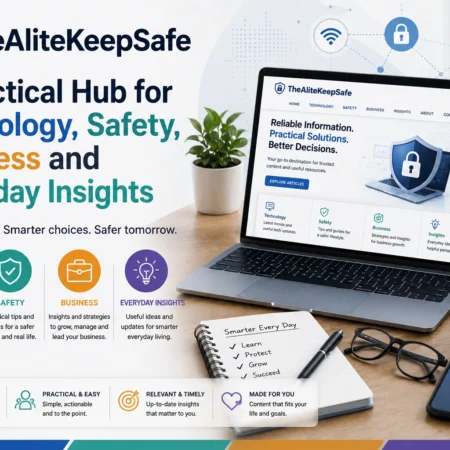
TheAliteKeepSafe is built around this idea. The site’s current description emphasizes helpful updates, useful resources and reader-friendly content in a simple, fast and easy-to-browse layout. Its categories cover a wide range of subjects, including AI, technology, business, finance, health, SEO, lifestyle, sports, food, education and news.
The website also provides dedicated areas for Guides, Reviews, Tips and Latest Posts, giving visitors several ways to discover information.
This article explores what TheAliteKeepSafe represents, the value of practical digital information, and how readers can make better use of online guides while evaluating information carefully.
What Is TheAliteKeepSafe?
TheAliteKeepSafe is a multi-topic digital information website focused on practical resources, useful updates and reader-friendly content.
Its current site structure includes categories such as:
- AI
- Technology
- Business
- Business & Finance
- Finance
- Health
- Health & Wellness
- SEO
- Lifestyle
- Education
- Food
- Sports
- News
- Cryptocurrency
- Entertainment
- Guides
- Reviews
- Tips
The breadth of these categories means that TheAliteKeepSafe is not limited to one narrow subject. Instead, it serves readers looking for information across technology, business, safety, lifestyle and other areas.
Why Practical Digital Information Matters
People generally search for information because they want to do something.
They may want to:
- Solve a problem
- Understand a new concept
- Compare products or services
- Learn a process
- Protect their information
- Improve productivity
- Make a better decision
- Stay informed
This means useful content should not simply provide facts.
It should help readers understand what the information means, why it matters and what they can do next.
1. Good Content Begins With a Real Information Need
Before creating an article, publishers should ask:
What does the reader actually want to know?
For example:
- What is this technology?
- Is this tool safe?
- How does this process work?
- What should I do first?
- What are the advantages and disadvantages?
- What mistakes should I avoid?
Starting with a real question creates a stronger foundation for useful content.
2. Direct Answers Make Articles Easier to Use
Many readers want the answer quickly.
A strong informational article can follow a simple structure:
Direct answer → Explanation → Example → Practical advice → FAQs
The reader gets the main point immediately and can then continue reading for additional context.
This structure is also useful for answer-focused search experiences.
3. Context Makes Facts More Valuable
A fact by itself may not explain why it matters.
Consider an article about data security.
Simply stating that strong passwords are important is useful, but limited.
A stronger explanation could also discuss:
- Why password reuse is risky
- How password managers work
- Why multi-factor authentication helps
- What to do after a suspected breach
- How to recognize phishing attempts
Context helps readers turn information into action.
TheAliteKeepSafe and Online Safety
Safety is a particularly relevant subject in a digital environment.
TheAliteKeepSafe’s current content includes practical safety topics such as protecting data, home security, food safety and medicine storage. Its homepage currently highlights articles including How to Keep Data Safe and Secure, Signs It’s Time to Upgrade Your Home Security System, and food-safety guidance.
4. Protect Important Online Accounts
Important accounts can include:
- Banking
- Social media
- Cloud storage
- Business platforms
- Shopping accounts
Basic security practices include:
- Using unique passwords
- Enabling multi-factor authentication
- Keeping recovery information updated
- Reviewing account activity
- Avoiding suspicious links
These steps do not eliminate every security risk, but they can reduce exposure to common account threats.
5. Recognize Suspicious Messages
Phishing attempts can arrive through:
- SMS
- Social media
- Messaging apps
- Fake websites
Warning signs can include:
- Unexpected requests
- Urgent payment demands
- Suspicious links
- Requests for passwords
- Unusual sender addresses
- Promises that seem too good to be true
When something feels unusual, verify it through an independent channel rather than responding immediately.
6. Keep Software and Devices Updated
Security updates can address known vulnerabilities.
Readers should regularly review updates for:
- Smartphones
- Computers
- Browsers
- Applications
- Operating systems
- Connected devices
Keeping software current is one of the simplest parts of maintaining digital security.
Food Safety Requires Practical Information
TheAliteKeepSafe also publishes food-safety content.
For example, its current guidance on keeping soup safe discusses temperature control, contamination prevention, cooling and reheating practices for food workers in the United States.
This illustrates an important principle of practical content:
Instructions should be specific enough to be useful while making clear when local rules or professional guidance apply.
7. Safety Advice Should Explain the Reason
Instructions become easier to follow when readers understand why they matter.
For example, food-safety guidance can explain that temperature control helps limit the growth of harmful microorganisms.
The reader is then more likely to understand the purpose behind the procedure rather than simply memorizing a number.
8. Rules Can Depend on Location
Safety requirements are not always universal.
Food codes, health requirements and other regulations can vary between:
- Countries
- States
- Counties
- Cities
- Industries
When publishing regulatory or safety content, the article should identify the relevant location and encourage readers to verify current local requirements.
TheAliteKeepSafe and Technology
Technology is another major part of the website.
The current site includes separate categories for Tech, Technology, Technology & AI, and Technology & Productivity.
Technology content can help readers understand new tools and how they affect everyday activities.
9. Technology Articles Should Focus on Use Cases
A technology article becomes more useful when it answers:
What can I actually do with this?
For example, an AI tool might help with:
- Content creation
- Research
- Video production
- Image generation
- Productivity
- Automation
Explaining use cases helps readers understand whether the technology is relevant to them.
10. AI Needs Balanced Explanations
AI is developing quickly, and users encounter new tools constantly.
TheAliteKeepSafe currently publishes AI-related content, including an article covering AI face-swap tools and other AI video topics.
Useful AI content should explain both:
Potential Benefits
- Faster workflows
- Automation
- Creative assistance
- Research support
- Productivity improvements
Potential Limitations
- Incorrect outputs
- Privacy concerns
- Bias
- Copyright questions
- Security risks
- Lack of context
Balanced information is more useful than presenting AI as either perfect or dangerous in every situation.
11. Compare AI Tools Based on Real Needs
Before choosing an AI platform, readers can consider:
| Factor | Question |
|---|---|
| Purpose | What do I want to accomplish? |
| Features | Does it provide the functions I need? |
| Quality | Are the outputs reliable enough? |
| Cost | Is the pricing practical? |
| Privacy | How is user data handled? |
| Ease of use | Can I operate it efficiently? |
| Limits | What can it not do? |
A tool should be evaluated according to the user’s actual requirements.
TheAliteKeepSafe and Business
The website also includes Business and Business & Finance categories.
Digital businesses increasingly rely on technology for:
- Marketing
- Customer management
- Communication
- Sales
- Accounting
- Data analysis
- Automation
- Collaboration
This creates a natural connection between business and technology content.
12. Business Advice Should Lead to Action
Readers usually gain more from specific steps than vague recommendations.
For example, instead of saying:
“Improve your business processes.”
a practical article could recommend:
- List repetitive tasks.
- Measure the time each task requires.
- Identify unnecessary steps.
- Evaluate automation opportunities.
- Test one change.
- Measure the outcome.
- Expand successful processes.
This gives the reader a clear starting point.
13. Technology Can Help Small Businesses
Small businesses do not always need complicated enterprise systems.
They may benefit from simple tools for:
- Scheduling
- Customer communication
- Payments
- Accounting
- Project management
- Email marketing
- Inventory
- Document management
The right solution depends on the company’s size, budget and workflow.
14. Automation Should Be Measured
Automation is valuable only when it creates a meaningful improvement.
Businesses can track:
- Time saved
- Cost reduction
- Error rates
- Customer response time
- Employee workload
- Conversion rates
Measurement helps determine whether automation is genuinely useful.
TheAliteKeepSafe and SEO
SEO is another category represented on the current website.
Search optimization can help readers discover useful information, but modern SEO requires more than repeating a keyword.
15. Search Intent Should Guide the Article
Different searches represent different goals.
Informational
What is local SEO?
The reader wants an explanation.
Research
Best SEO tools for small businesses
The reader wants to compare options.
Practical
How to improve local search visibility
The reader wants instructions.
Navigational
TheAliteKeepSafe
The reader wants to find a particular website.
Understanding intent helps determine the appropriate article format.
16. Answer the Primary Question First
A useful article should not make readers hunt for the basic answer.
A simple structure is:
Short answer → Details → Examples → Practical steps → Related questions
This is useful for both human readers and search systems that need to understand the page’s main subject.
17. Build Content Around Topics, Not Just Keywords
Instead of creating separate articles for every tiny keyword variation, publishers can create useful topic clusters.
For example:
Online Safety Cluster
- How to protect personal data
- How to recognize phishing
- Password security basics
- Multi-factor authentication explained
- How to secure social media accounts
- What to do after an account breach
These articles can support one another through relevant internal links.
TheAliteKeepSafe and Guides
The site currently provides a dedicated Guide category and also organizes content through its Guides section.
Guides are particularly useful when readers need to complete a task.
18. A Good Guide Has a Clear Goal
A useful guide should make the desired outcome obvious.
For example:
Goal: Protect your important online accounts.
Then the guide can walk through:
- Passwords
- Multi-factor authentication
- Recovery options
- Device security
- Phishing awareness
- Account monitoring
Clear goals prevent unnecessary information from distracting the reader.
19. Use Checklists for Practical Topics
Checklists are useful because readers can quickly verify whether they completed each step.
For example:
Online Safety Checklist
- Unique passwords
- Multi-factor authentication enabled
- Recovery email updated
- Devices updated
- Suspicious links avoided
- Important data backed up
Simple formats can make complicated subjects easier to manage.
TheAliteKeepSafe and Reviews
The website also provides a dedicated Reviews section.
Reviews can help readers evaluate products, platforms and services before making decisions.
But a useful review should be balanced.
20. Explain Who a Product Is For
A product may be excellent for one audience and unsuitable for another.
A review should consider:
- Target users
- Key features
- Ease of use
- Pricing
- Performance
- Limitations
- Alternatives
This gives readers enough information to make their own judgment.
21. Reviews Should Discuss Limitations
A review that only lists benefits can feel promotional.
A stronger review explains both:
What works
and
What may not work for every user.
This creates a more realistic picture.
22. First-Hand Testing Adds More Value
When possible, product and software reviews can become more useful through actual testing.
Testing can examine:
- Setup
- User interface
- Speed
- Features
- Reliability
- Customer support
- Real-world performance
First-hand experience creates information that generic product descriptions cannot easily provide.
Health Content Requires Additional Care
TheAliteKeepSafe has multiple health-related categories, including Health, Health & Beauty, Health & Nutrition, Health & Supplements and Health & Wellness.
Health information should be handled carefully because readers may use it when making important personal decisions.
23. Keep General Information Separate From Personalized Advice
An article can provide general educational information.
It should not assume that the same advice is appropriate for every individual.
For symptoms, diagnoses, medications or treatment decisions, readers should seek advice from an appropriately qualified healthcare professional.
24. Use Appropriate Sources
Health claims should ideally be checked against credible sources such as:
- Government health agencies
- Hospitals
- Universities
- Medical organizations
- Peer-reviewed research
The stronger the claim, the more important the evidence.
Keeping Digital Content Current
One challenge with online publishing is that information changes.
Technology evolves.
Software receives updates.
AI tools introduce new features.
Prices change.
Regulations can change.
Safety guidance can be revised.
25. Review Older Articles Regularly
A useful content-maintenance process includes:
- Check the publication date.
- Review major factual claims.
- Test important links.
- Update outdated examples.
- Check product or software details.
- Add new context where necessary.
- Correct errors.
- Update the article when meaningful changes occur.
This helps maintain long-term usefulness.
26. Date-Sensitive Topics Need Extra Attention
Certain subjects can become outdated particularly quickly:
- AI tools
- Software
- Technology
- Finance
- Travel
- News
- Health guidance
- Regulations
Readers should be able to understand when the information was published or last updated.
Building Trust With E-E-A-T
E-E-A-T stands for:
Experience
Expertise
Authoritativeness
Trustworthiness
These principles are particularly important for a broad publication.
27. Match Expertise to the Subject
Different subjects require different types of expertise.
For example:
- Technology → technical knowledge
- Business → relevant business experience
- Health → appropriate health expertise
- Finance → financial knowledge
- Food safety → food-safety expertise
- Travel → current destination knowledge
A broad publication should not assume that one generic author profile establishes expertise for every topic.
28. Make Authorship Clear
Author information can help readers understand:
- Who wrote the article
- What experience they have
- What subjects they cover
- Why they are qualified to discuss the topic
Clear authorship is particularly useful for specialized content.
29. Support Important Claims
Important factual statements should be supported where appropriate.
Useful sources may include:
- Official government resources
- Universities
- Research organizations
- Professional bodies
- Official product documentation
- Primary sources
Source quality matters more than simply having a large number of citations.
30. Correct Meaningful Mistakes
Mistakes can happen even with careful editorial review.
When significant inaccuracies are identified, correcting them openly is better than leaving incorrect information online.
A transparent approach can strengthen trust.
The Future of Practical Digital Content
The way people find information is changing.
Readers now use:
- Search engines
- Social networks
- Video platforms
- News feeds
- Online communities
- AI assistants
This means digital publications need content that can work across different discovery environments.
31. Conversational Search Changes Content Structure
People increasingly search using complete questions.
For example:
“How can I keep my personal data safe online?”
A useful article should answer that question immediately and then provide deeper explanations.
This approach is valuable for both traditional search and AI-powered answer systems.
32. Original Experience Is Becoming More Valuable
Generic explanations are increasingly easy to generate.
Original information is harder to replicate.
Examples include:
- Product testing
- Original research
- Expert interviews
- Case studies
- First-hand observations
- Unique comparisons
- Real-world examples
These elements can make content more useful and distinctive.
33. Readers Want Practical Outcomes
The strongest digital content often answers:
What should I do with this information?
That could mean:
- A checklist
- A step-by-step process
- A comparison
- A decision framework
- A troubleshooting guide
- A list of precautions
Information becomes more valuable when it leads to a useful outcome.
A Practical Content Framework
Whether an article covers technology, business, safety, health or lifestyle, this structure can work well.
Step 1: Identify the Reader
Who needs the information?
Step 2: Identify the Question
What are they trying to understand?
Step 3: Give the Direct Answer
Do not hide the main point.
Step 4: Add Context
Explain why it matters.
Step 5: Provide Examples
Make the concept practical.
Step 6: Explain Limitations
Tell readers where the information may not apply.
Step 7: Give Next Steps
Provide something useful to do.
Step 8: Answer Follow-Up Questions
Use FAQs to address related searches.
Step 9: Verify Important Information
Check dates, facts and sources.
Step 10: Update When Necessary
Keep valuable content current.
Common Digital Publishing Mistakes
Writing Without a Clear Purpose
Readers should know what they will gain from an article.
Chasing Every Trend
Popularity does not automatically equal usefulness.
Overusing Keywords
Natural language creates a better reading experience.
Making Unsupported Claims
Important statements should be verified.
Ignoring Expertise
Specialized subjects require appropriate knowledge.
Making Reviews One-Sided
Readers need both benefits and limitations.
Forgetting Content Updates
Old information can become misleading.
Giving Generic Advice
Specific examples make information easier to apply.
10 Principles for Better Digital Content
- Start with a genuine reader question.
- Give the main answer early.
- Use clear and natural language.
- Add relevant context.
- Provide practical examples.
- Use appropriate sources.
- Match expertise to the topic.
- Explain limitations honestly.
- Update important information.
- Focus on helping the reader take the next step.
Frequently Asked Questions
What is TheAliteKeepSafe?
TheAliteKeepSafe is a multi-topic digital publication focused on helpful updates, useful resources and reader-friendly information. Its current site covers subjects including AI, technology, business, health, SEO, lifestyle, sports, food, education and news.
What topics does TheAliteKeepSafe cover?
The website currently includes categories covering AI, technology, business, finance, health, SEO, lifestyle, education, food, sports, entertainment, cryptocurrency, news, guides, reviews and tips.
Does TheAliteKeepSafe publish technology content?
Yes. The site has dedicated technology-related categories, including Tech, Technology, Technology & AI, and Technology & Productivity.
Does TheAliteKeepSafe cover online safety?
Yes. Its current content includes subjects such as data security, home security and food safety, alongside broader technology and lifestyle topics.
Why are practical guides useful?
Practical guides turn information into actionable steps. They can help readers understand a process, avoid common mistakes and complete a task more confidently.
How should readers evaluate online information?
Readers should consider the author, publication date, sources, evidence and whether the information can be independently verified. Extra care is appropriate for health, financial, legal and security-related topics.
What is E-E-A-T?
E-E-A-T means Experience, Expertise, Authoritativeness and Trustworthiness. These principles emphasize the importance of relevant experience, appropriate expertise, credible information and transparent publishing practices.
Conclusion
TheAliteKeepSafe represents a broad approach to digital publishing in which practical information can cover many parts of modern life.
The current website combines technology, AI, business, health, SEO, lifestyle, sports, food, education, news and other subjects within a single information environment. It also provides dedicated sections for guides, reviews, tips and latest posts.
That broad scope can be valuable because readers rarely have only one type of information need.
A technology user may need security advice.
A business owner may need productivity guidance.
A consumer may want a product review.
A food worker may need safety information.
A general reader may simply want to understand a new trend.
The underlying requirement remains the same:
The information should be clear, useful, accurate and appropriate for the subject.
As AI changes content production and search behavior, this becomes even more important.
Generic information is increasingly easy to create.
What stands out is information supported by:
- Real experience
- Appropriate expertise
- Reliable sources
- Useful examples
- Clear explanations
- Practical recommendations
- Regular updates
For TheAliteKeepSafe, continuing to build around these principles can help turn a broad collection of articles into a more useful information resource.
The goal of digital publishing should not simply be to give readers more pages to read.
It should be to help them understand something, solve something, evaluate something or make a better-informed decision.
That is what gives practical online content lasting value.

Other Articles


No Comment! Be the first one.